

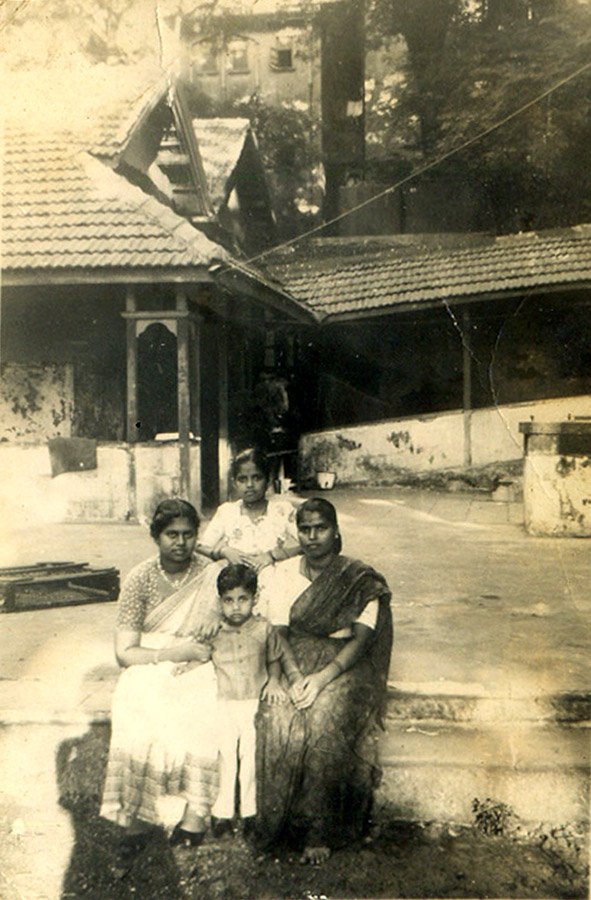
Image and Narrative contributed by Joe Joseph Zachariah, Mumbai
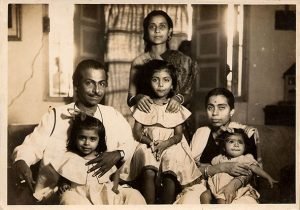
This is a picture taken in the late 50s by my dad Mr. O S Joseph and each time I look at it, it evokes several fond memories of my childhood.
The four-storied building seen behind is Rustom Baug in Byculla, a Parsee colony in Bombay. Every year on first monsoon rains my dad would make me stand by the white pail. “having bath in the first rain cures you of all illnesses” he would say. In retrospect, I now see why that spot was good because all the water from the tiles converged at that spot.
I have no memory of this picture being photographed but I will also never forget the Kelkar family. Our next door neighbours. Here Mrs. Kelkar is with her daughter Shalini. I used to call her Aai (mother in Marathi) Aai was more conversant in Marathi than with Hindi and my Marathi wasn’t very good, but we used to get along well. She used to pamper me a lot.
I remember the Kelkars had a huge radio in their drawing room (living room) with high ceilings built by the British. But what fascinated me more was the extension speaker, which was in the kitchen. I used to sit on the small stool in the kitchen observing her as she went about happily doing her daily chores of cutting vegetables, cooking, heating the water for husband’s bath and all the while singing a very famous marathi song “Me dolkara, dolkara dolkara dariyacha raja, Vallhav re nakhwa ho vhallav re rama” along with the the radio on India’s only radio network at the time, All India Radio. I remember deciding then, that when I grow up and have my own house I will listen to the radio and have an extension speaker in every room.
The best time to be in the Kelkar’s house was during the “festival of lights” Diwali, or rather the month before Diwali because of the lovely aroma of the sweets being made in the kitchen. I had free access to all the sweet boxes and it was one of the reasons why my dad forbade me several time to go there during Diwali. Sharad, Aai’s eldest son was another influential figure during my childhood. The way he would construct the aakash kandil (paper lantern) was nothing short of perfection. He was very forthright & responsible and even though I could not understand much Marathi at the time, I could make out that he was someone who had some principles and was fair in all dealings.
Today, I don’t have an extension speaker but a radio sits in my bed-room and is almost always on for 24 hours. There is nothing better than listening to the good old songs.
4 Responses
Joe – I too have the radio on in the kitchen all the time but it is to listen to NPR.
:-), still agree with you nothing like listening to old beloved songs and singing along..
Yes Vijee, nothing like listening to the old songs. Now it is streaming music from the Internet for me (after the demise of the World Space in India)
By the way what is NPR?
Nice story — Thanks for sharing.
Thanks for the comment Vijee. Glad you enjoyed it.