

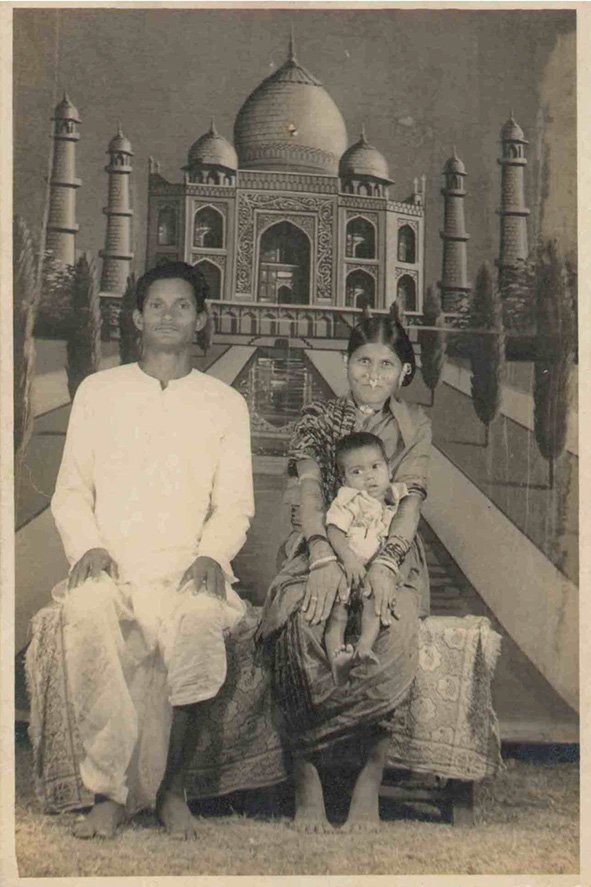
Image and Narrative points contributed by Samant Sahu, Mumbai
Volunteer Assistance : Sandeep K, Mumbai
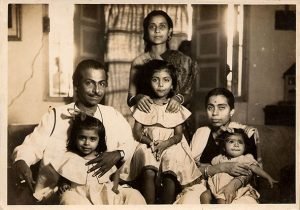
This picture was taken at the Meena Bazaar Photo studio in Kesinga (Orissa) and it has my grandparents Jagajiban and Kanak Sahu with their fourth son Shwetabahan.
My grandfather Jagajiban was from Bagad Kesinga, Kalahandi district in Orissa (now Odisha) and was the eldest in the Sahu family followed by four younger sisters and a brother. Even as a 10th standard high school dropout he somehow managed to get a job as a government teacher and taught mathematics and science to primary school students. He got married at the age of 20 to my grandmother, Kanak. As a young boy, Jagajiban was interested in serving society and was a renowned name in his village Bagad for his contributions towards the development of his fellow villagers.
In 1967, he happened to meet with an Ayurveda physician in the near-by forest. The physician was looking for a herb to prepare a medicine and after few minutes of interaction, Jagajiban discovered that he had written Rasayana Kalpadruma, an ayurvedic book that proposed the ultimate solution for youthfulness. Jagajiban returned home impressed and influenced by the science of Ayurveda. So much so that in 1968 he convinced his wife that he must leave with the physician to Berhempur to learn the art and science of Ayurveda practices. Over time he garnered an in-depth knowledge about Ayurveda and herbs that could cure some of the most dangerous and infectious diseases. In 1971, he returned to his village and began practicing in his village, offering ayurvedic treatments for free. He was famous for treating people with snake & scorpion bites and was believed to cure people just by chanting mantras.
One of the foremost contributions to the country by Jagajiban was when India was in the midst of the Sino-Indian war in 1962. The papers were abound with news that the government of India had spent much of its money on war and was in deep crisis. Jagajiban decided to do something about it and marched across Kalahandi district to create awareness among the villagers. He asked for their help to save the country resulting in contributions in gold and money from farmers and villagers. He also donated much of his own personal wealth. When the government chose to honour his contributions, he denied it – saying that it was only his duty.
The people of Bagad have now established a botanical garden named the Tengra Garden that is used for research in Ayurveda and is managed by Jagajiban’s son, my father. My grandfather Jagajiban Sahu passed away on February 4, 2016.
One Response
Thanks for providing a tremendous history about Bagad. Anup dash