Image and Narrative contributed by Mudar Patherya, Kolkata
IMP Research Intern – Mehr Puri, Presidency University, West Bengal
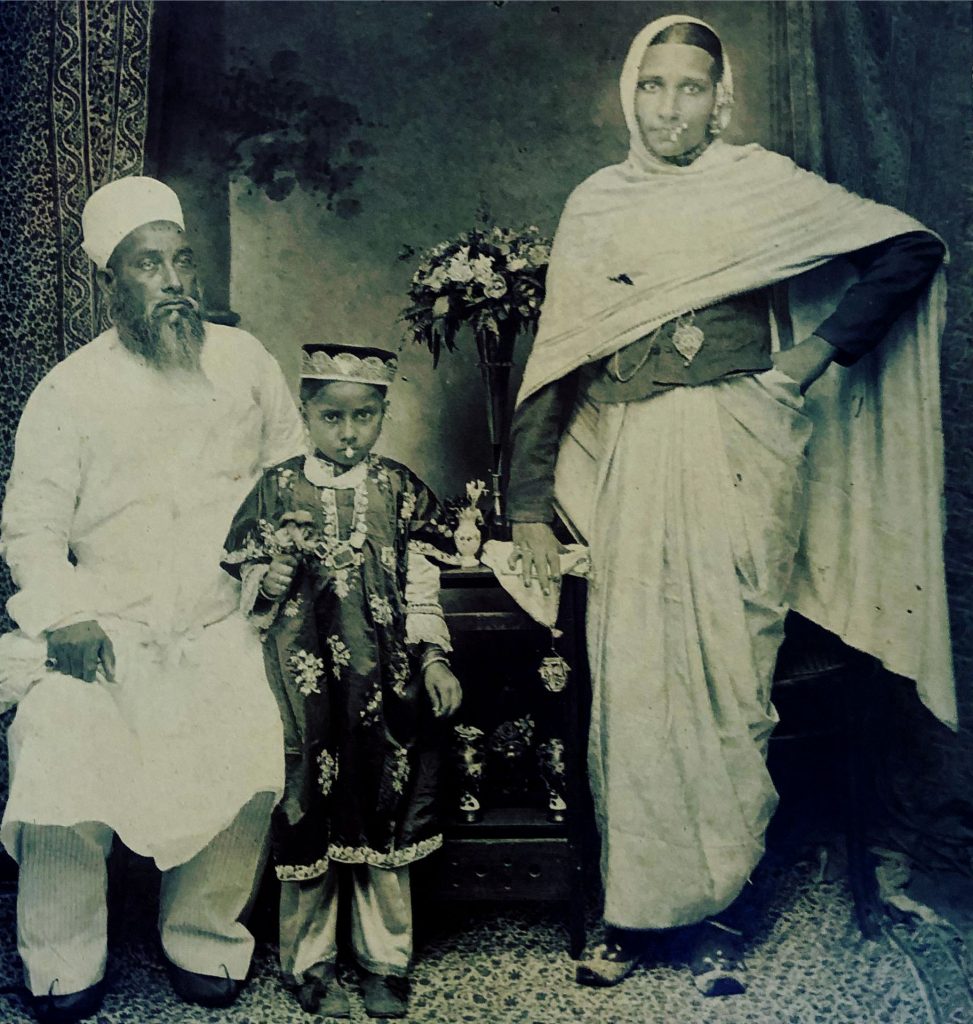
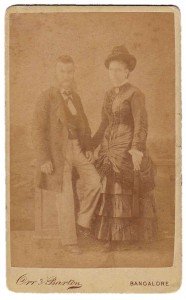
A few years ago, while I was trying to piece together my extended Surati Bohra (Dawoodi Bohras from Surat, Gujarat) family tree, I chanced upon a few photographs that had lain forgotten between photo album sheets for over a century. Photographed circa 1904, this picture could very well be one of the oldest family treasures we have, and it took me some time to ascertain who the people in these photographs were. That little girl in the photograph is my paternal grandmother Kulsum Bengaliwala (née Bengaliwala), and the adults are her parents – my great-grandparents. But we didn’t know their names, and even my father’s sister, my aunt, couldn’t remember.
Nonetheless, after some good old community sleuthing, we believe their names are Bawaji Abdulkayum Hathiwala and his wife Maryamboo. Taken in the Dhunjishaw & Gazdar photo studio in Bombay in 1904, it appears they had travelled 300 kilometres to the studio from Surat, in Gujarat, to get themselves photographed. We know that the Hathiwala family came from great wealth, and travelling to Bombay to have one’s photograph taken was at the time an important event, undertaken with enthusiasm by the wealthy and influential classes of South Asia.
I felt drawn to this photograph in particular because I had never seen this set of my great-grandparents. Moreover, I was intrigued by the manner in which they were dressed. The man in the picture, my grandmother’s father, Bawaji Abdulkayum Hathiwala, appears to be quite tall. He wears traditional Surati Bohra attire – a long kurta called a Pehran that ends just above his ankles, and pyjamas that are broad and wide, unlike the tapered ones preferred today. Even the white headgear he wears is of a traditional style that was in use in the last century, until people switched to a black headdress and eventually to a white topi with golden ornamentation at the base. Their surname, Hathiwala, derives from the vernacular word hathi – meaning elephant. The lore is that my grandmother’s family would send heaps of clothes to the dhobi ghats, carried on the backs of elephants, and thus the name – Hathiwala. It is also possible that the family was involved in the textile trade, as many Bohra families from Surat were known to be, and elephants carried reams of their textiles to be washed on the ghats.
What is surprising is that in the photograph, unlike my reticent great-grandfather, the lady – my great-grandmother Maryamboo – stands boldly, in a traditional Gujarati Bohra-style sari distinct to the early 20th century. A second piece of cloth, a dupatta, drapes her torso and her head. In a conservative Muslim household, the head would never have been exposed, but here, a section of her head is left uncovered. Her dark fabric blouse contrasts with the lighter lower garment, and the jewellery and size of her nose ring are a deliberate presentation of wealth and status.
But mostly, I am bemused by her stance in the photograph. Arranged by the photographer, as most studio poses are, her left hand rests on her waist and she looks directly into the camera – a posture of confidence and defiance. My great-grandfather is seated back and stares into the distance. The little girl, my grandmother Kulsum, stands closer to her father than her mother, which may reflect a relationship dynamic or the photographer’s curation. Kulsum wears a large nose ring, a long, richly embroidered kurta that falls below her knees, and on her head, a beautiful gold-embellished cap characteristic of Bohra traditional style.
My grandmother Kulsum was born in Surat in the late 1890s, and came to Calcutta (now Kolkata) after marrying into my paternal side of the family – the Bengaliwalas, who were also originally from Surat. The story of how the Bengaliwala surname came about is also interesting. We are a trading community, which lends us our traditional surname, Bohra – ‘trader’ in the vernacular. In Surat, hundreds of families would share the same surname, but the moment a family migrated out of the city, they would be identified by the destination or the region to which they had moved. So, the Bohras who went to Madras became Madraswala, the ones who went to Calcutta were the Calcuttawala, and our family came to be known as the Bengaliwala. Today, Kolkata has only a few Bengaliwalas left.
The Bengaliwala family that my grandmother had married into migrated from Surat to Calcutta in 1843, during the British colonial era, seeking better economic prospects. The elders in our family say that the journey from Surat to Bengal was a three-month-long, arduous trek traversed on a bullock cart. Their first commercial trading establishment was at the corner of Rabindra Sarani and Colootola Street, in an area then known as ‘Black Town’ (Black Town was where the local Bengalis resided, and White Town was where the British and other Europeans lived), where they began importing and exporting goods between Surat, Calcutta, and further east into the Orient. It seems the family must have done reasonably well, as they were able to bring their families from Surat to Calcutta.
Kulsum’s husband, my paternal grandfather Mohammed Bhoy Patherya, too, had a reasonably successful business, but once he passed away, the family virtually had no source of income. In my research, I came across old letters that mention a tax claim and narrate how the family lost its income. While my grandmother Kulsum was not formally educated, she ensured that her daughters were able to access education, which was usually not encouraged in our community, and it proved useful when they had to step up and begin earning an income. My aunts were probably the first women from our community to work – and it was a really big deal. English-medium education had become more accessible after the Second World War, and as Anglo-Indian women began joining the workforce, more and more women from other communities, including ours, began to follow suit.
It is unfortunate that I did not get to meet my grandmother Kulsum, as she passed away a year after I was born in 1962. All I know is that she was a soft-spoken woman. While trying to create my genealogical tree, I noticed that most of the male members of the family are documented, but there is barely any evidence of the women – not even their names. Nonetheless, I am happy that I now have two photographs of my grandmother Kulsum and my great-grandparents – and they are no longer forgotten.
One Response
My name is Talib Sheikh a bohora born in Mombasa Kenya 5th generation in Mombasa
My ancestry is from jam Khambhalia
My great great grandfather Sheikh essaji Mulla bhaijee arrived in Mombasa as a priest to preside over a growing community
He set up business in Mombasa and served the community for over 50years
Died in Mombasa at a grand old age of 102
We still live in Mombasa and the family
Has been in Mombasa since the last 180 years