Image and Narrative contributed by Mrudula Prabhuram Joshi, Mumbai
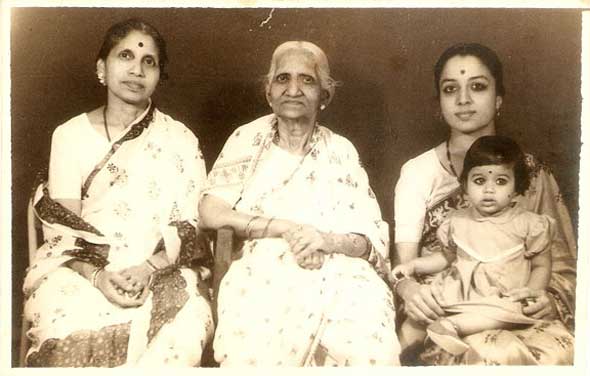
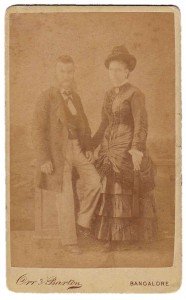
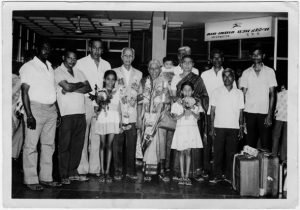
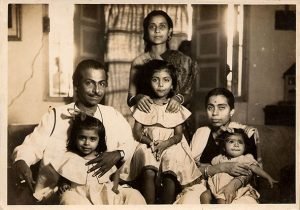
Kamala Vijayakar, my grandmother (sitting, center) was born in 1890 in a well-to-do Pathare Prabhu family in Bombay. Pathare Prabhus are the original residents of the Bombay Islands along with the Agaris, the Bhandaris and the Kolis since 700 years. They are known to be a small, close-knit, and a 100 % literate community. Kamala was a bright student of the Alexandra Girls’ School. She passed her Matriculation exam in 1910 and joined St. Xavier’s College for higher education the same year. She was ”the first Hindu girl student” of this esteemed college. She excelled in higher studies and was preparing for the First Year Arts examination when she got engaged to Mr. Narayan Vijaykar, who was an artist but non-matriculate. According to the prevalent norms, the wife could never be more educated than the husband, so she had to give up college education, start family life, raising children and fulfilling the duties of a good housewife.
Settled in Malad, a distant suburb in Bombay, she began taking a keen interest in the Local District Board activities and the emancipation of women around her. She was a fluent and forceful speaker in English, and was appointed as the Honorary Magistrate at Malad. A lady Magistrate was a major novelty in those days and people would throng the courts when she delivered her judgments. When she left her home to go to the courts, people would stand on both sides of the road just ”to see ” how a lady magistrate looked. She had long innings at the Malad District Court. Kamalabai Vijaykar was appointed ”Justice of Peace ” (Honorary Magistrate) by the government, and she later became popular as ”J. P. Kamalabai ” all over Bombay. She was also a staunch Congress-woman.
All her life, she held Education dear to her heart. Her own children, 7 in all, fulfilled her own dream of becoming Graduates and Double-graduates. She lived long enough to see even her grandchildren become double graduates. She breathed her last on 8th August, 1972, at the ripe old age of 82, content in the knowledge that she had done her bit to empower at least some women around her by providing for their education.
3 Responses
Since there is no easy way to contact the author, there is a photo and a note in _The Modern Review_ January 1934. p. 95 – the photo can also be seen at https://commons.wikimedia.org/wiki/File:Kamalabai_N._Vijaykar.jpg
My mother too went to Xavier’s college albeit, much later in 1936. She wanted to become a doctor. She quit within a few months because her father insisted she wear a nine-yard sari at college when the other girls came in frocks or 5 yards saris. She joined a residential nursing school where she could wear a 5 yard sari!
As a teacher of History at St. XAvier’s College, this piece throws faint light on the statistic of who were the first “women” students of St.XAvier’s College. I would like to know more.