


Image and Narrative contributed by Late. Anand Halve, Mumbai
India is more varied and diverse than reflected in the languages on Indian currency notes or in the number of states and Union Territories on our map. This is a piece about a group of ‘Indians’ that will probably vanish before most Indians ever even hear of them. The Ongee or Onge tribe, are one of the indigenous Andamanese tribes. A negrito tribe of the Andaman Islands. Petite and superficially ‘African’ in appearance, dark skinned and peppercorn hair, they are still genetically different from most modern African people.
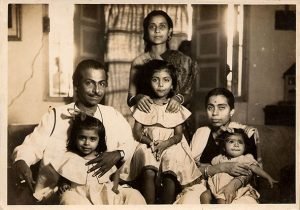
Until the late 1940s, the Onges were the only permanent occupants of Little Andaman, the southernmost island in the Andaman group of 324 islands. The Non-Onges began to settle on Little Andaman in large numbers in the early 1950s. Among the earliest visitors – in the early 1960s – was a seven year-old boy (me) and his six year-old sister Jyoti. My father, Bhaskar Halve was posted as the Deputy Commissioner of the administration of the Union Territory of Andaman & Nicobar. His job took him to study various islands in the Andaman & Nicobar group, and we were only too happy to tag along.
The Onges are a traditionally nomadic hunting and gathering tribe. I recall stories told to us by the sailors who visited the islands where the Onges lived. The Onges were masters of the bow – I recall watching an Onge spear a fish through the refracted sea-water with his arrow. I recall stories of a strange plant whose leaves they chewed, and after rubbing the chewed juice on their bodies, were able to climb trees and pluck chunks of honeycombs, untroubled by the bees. I recall stories about the cannibal Jarawas (a tribe related to the Onges), but the sailors laughingly told us that the Ongees were friendly. Yet you can see a certain trepidation in our expressions as we posed with Ongee kids for a photograph. However, they were friendly enough and we got along without knowing each other’s language, as only children can. It still makes me smile.
As of recent information I believe there are fewer than 100 Onges left, and with their low fertility rates, are on the verge of disappearing forever into a footnote of history. But I hope there are a couple of old anonymous Onges out there who remember playing with a couple of kids from the mainland…as I remember them.

4 Responses
Mind-blowing… and heart-warming. It is saddening to think how marginalised we have made the Ongees and others in A&N and elsewhere. Why can’t we live and let live.
THank you for sharing this story.
Beautiful.
The facial features and the hair seem to be that of people of Africa – like the Bantu – found in Kenya, Tanzania…
There are also the Sidi peoples in Jamnagar, Gujarat, western India, who are said to have come from Africa, possibly to trade or to have been brought as slaves from Africa…
It seems very likely that the Ongees came from Africa – ?
Actually, these tribes such as the Onge, Sentinelese, Jarawa, Great Andamanese Tribe and several others in Nicobar islands have inhabited that region for over 60,000 years. They do have genetic differences with Africans and as is seen, the same negrito race mixes with the eastern Asian races in South east Asia. Migrations from Africa could have been a reality but evidence does tilt towards them being there from the beginning.