

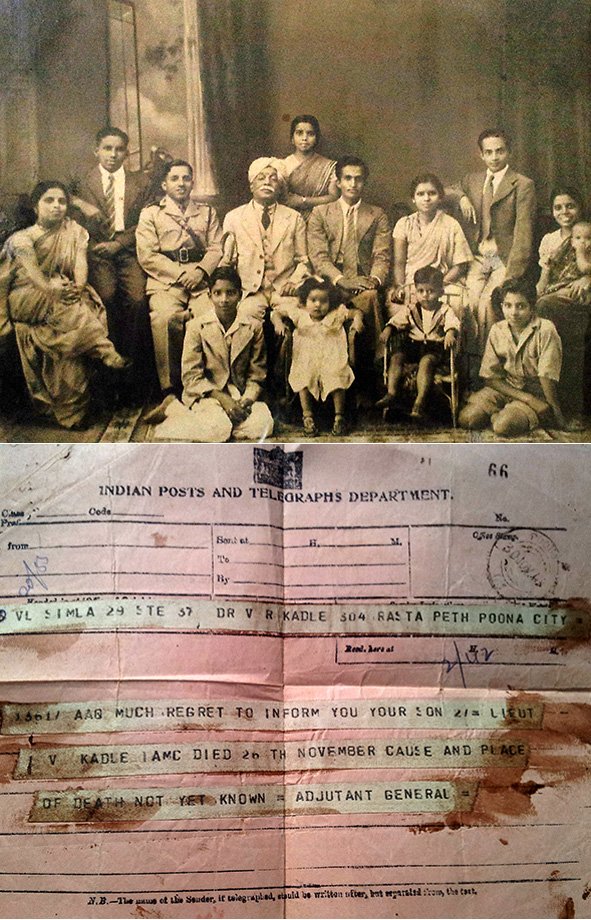
Image and Narrative contributed by Udit Mavinkurve, Mumbai
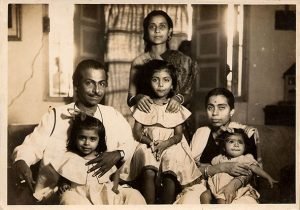
In this photograph Purushottam Venkatrao Kadle, (standing rightmost) fondly called Vasant is my grandfather. He was 17 years old at the time. The photograph was taken, in honour of his elder brother, Lieut. Laxman Kandle, (sitting, in uniform) who was leaving for his duty as a medical officer in the military. He had been posted in Bengal for famine relief. The Bengal famine of 1943 had struck the Bengal province of pre-partition British India during World War II following the Japanese occupation of Burma.
A mystery surrounds my grand-uncle Laxman. He never returned from Bengal, they tell me. A telegram arrived, with its customary terseness, which said he had died; cause and place of death, unknown. His body was never found. And a few days later, they got a letter from him, written when he had been alive. A pre-teen under the heady influence of a great English teacher, I fantasized about a novel I would write about him when I would grow up. That was back in 2005.
Last month in December 2013, during our annual cleaning, my mother found the said letter and the telegram that my grandfather Vasant, Laxman’s youngest brother had kept for all these years. And the dust covered letters awoke those pre-teen fancies of writing about my uncle yet again. (The letters are presented in the links below)
The first letter offers more than mere curiosity of any Indian seeking out people from his own community when in strange land. The Kadles, the Koppikars, the Manjeshwars and the Kulkarnys are families from the relatively small Konkani-speaking community of Chitrapur Saraswat Brahmins, rooted mainly in parts of Maharashtra and Karnataka. Laxman tells his father about the fellow Chitrapur Sarasawats he met in Calcutta (now Kolkata), Bengal (now West Bengal). One notable thing was his concern for the women of his family – he asks after his ill mother, his dear sisters and even his young niece Jayashree, but doesn’t mention his brothers, or his nephews. Nevertheless, it was the second letter I found particularly moving.
In the second letter, he describes his memorable journey along the River Padma (now in Bangladesh), that was something he would never forget. He describes the painful plight of the victims of the 1943 Bengal famine. He seems genuinely moved. And yet, through it all, there pervades a sense of purpose ; His will to serve and to be of use. He wrote about the arrangements he had made regarding money for the family, words sounding almost ominously like words from a will & testament.
But the fact that the second letter reached the hands of his father after the telegram with news of Laxman’s death is what makes it almost like a Greek tragedy. I imagine my great-grandfather holding the letter, reading the words of his dead son whose body was never found describing his joys, worries and plans; and my 17 year old grandfather, Vasant, standing beside him, an awkward teenager. With a chronically ill mother and a shocked father, the death of an elder brother might not have seemed mysterious and romantic to him, as it does to me. And yet, it was he – of all the others – who kept these letters, safeguarded, for all these years. My grandfather couldn’t have been very different from me.
[For more information on this narrative, scroll down to comments]
4 Responses
well portrayed Udit….have good command on language…. keep it up..
good job sangeeta u preserved this treasure
The amount of history and stories buried in our families man.. This is amazing. This kind of story can never be lost or forgotten with generations.
And of course, the way his mother found out was so cruel. Fate is like that sometimes.
Dear Udit,
Priceless memories & Beautifully written!! Can already see the makings of a great Author.
Anantmam read everything and was deeply moved by all the nostalgic memories that they evoked. He sends you his Gratitude and Best Wishes. He said that his Mother was not informed about this sad news for many months. She was bed-ridden (he guesses with Diabetics) and always asked her husband whether there were any letters from Laxman. His father would write letters on behalf of Laxman and read them to her. She came to know the news only after 6-7 months. The lady who delivered milk (in those days the buffalo came right to the doorstep and was milked right in front of the house) went up (they were staying on the 1st floor) to meet your Great-Grandmother and not knowing that this was to be kept a secret mistakenly let this sad news slip to her.
Keep up the good work and do carry through your dream of authoring a book. I almost had the feeling of reading the preview of Vikram Seth’s ‘Two Lives’. Do come and stay with us and talk to Anantmam for your book. He will be able to share with you many personal memories of those wonderful years when simultaneously a Mighty Nation was shaking off its shackles and taking new birth.
Very well-written, Udit! We are proud of you!