

Image and Narrative contributed by Pritpal Virdee, UK
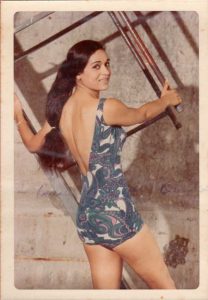
This is a picture of my mother, Satwant Kaur Virdee photographed in Ludhiana, Punjab around the late 1960s. She was born in Nurpur, near Lahore (now Pakistan) in 1929 and later moved to Kot Badal Khan, Jalandhar district (now India). It was one of the many journeys and migrations my mother would make in her lifetime; initially with her mother and father, Daya Singh, and then with my father Prem Singh Virdee after marriage, circa 1945.
She spent time at Nangal when Bhakra Dam was being constructed (my father was a mechanical engineer) then Phillaur, Ludhiana, Nakuru, Nairobi and finally Coventry, UK. Moving across three continents with her daughters in tow – a sewing machine too was always essential. This picture represents so much of the migration history that epitomises modern life, the Punjabi diaspora and our own personal family history.
Migration from the Doaba area of Punjab has been prolific and in our family, it started initially with my maternal grandfather. Doaba is now called the ‘NRI Hub of Punjab’ as a consequence of a significant percentage migration of the Doabias. By the 1960s, my father also ventured into East Africa, taking advantage of family and colonial linkages. He spent time working in Nakuru, Kenya and my mother spent time in Ludhiana; father would often bring “foreign” gifts for his daughters when he returned home. He would buy bicycles, radios and other modern consumables, including a camera for his girls. My mother told me he was quite progressive in his thinking and despite us being girls, he wanted us to have the latest gadgets.
Scanning the old family photograph album after my mother passed away in 2012, I came across this picture of my mother sitting in the verandah of our house in Ludhiana. She’s sitting there with an old sewing machine, a need and passion that would remain with her for the rest of her life. Having no formal education, she was nonetheless, astute and nimble with her fingers. Creating many wonderful pieces of art, many of which I have carefully treasured. From this hand-wheel sewing machine she advanced to the computerised Bernina, taking to it like pro, and I still have that Bernina.
The photo is also unusual because it’s not taken in a studio, the norm at the time. Most likely, it was my sister who took this photograph. In its messiness, it shows everyday life, yet it also captures the grace my mother had until the end of her life.