
Image and Narrative contributed by Suryanandini Narain, New Delhi
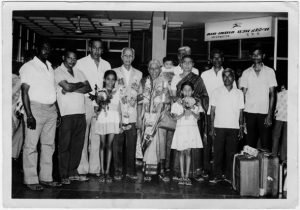
In 1980, Raka Prashad, my husband Azeez Narain’s mausi (maternal aunt) undertook a meaningful four-day trip to Dhanbad’s coal mines, in Bihar (now in Jharkhand) as an MA student of Industrial Psychology at Delhi University. This photograph reveals the story of Raka’s attempt to comprehend the loss of her father 18 years ago, through a physical re-visitation, and emotional re-calibration.
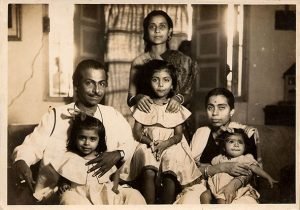
Raka’s father, Prem Prashad was born in 1921. A bright man, he went on to study at St. Stephen’s College in Delhi, then at the Indian School of Mines at Dhanbad (now IIT Dhanbad), and finally at University of Birmingham in the UK. In 1951, he married Sudha Kishore and built a life as a young family in Asansol, West Bengal where he served as General Manager for the Coal Mines near Asansol (now Asansol Coal Mines). Their life was an idyllic one – with a large home, many visitors and frequent family holidays.
A part of Prem Prashad’s duties was to engage with the coal field sites on a daily basis. This meant that he frequently visited the offices, and the coal fields, going down the mine shaft to supervise the manual excavation of coal. In 1964, on a fateful day, he went down the mine shaft in a routine manner, but never surfaced. He had suffered a cardiac arrest in the mines, leaving behind a young family.
Raka was only seven-years-old, a middle child, with an older sister Surekha, a younger one, Meeta and an infant brother, Pranav. The young family left Asansol for good the same year and settled in Delhi, closer to extended family and friends, and with better educational opportunities for the children. 18 years later in 1980, when an opportunity for her college batch’s annual field trip came up, it was on Raka’s suggestion that the faculty at her department agreed to a trip to the Dhanbad site (an hour away from Asansol). For the students, this was an opportunity to undertake field-based observations necessary for their degree. The trip was hosted by the Indian School of Mines (now IIT Dhanbad), and Raka, her classmates and her teachers were all accommodated at its guest house.
Raka had felt a deep need to confront the place where her father had breathed his last. She superimposed her desire for closure from the incident at Asansol, with the visit to the mine at Dhanbad. Considering she had never been inside a coal mine, Raka bravely donned a hard hat, and surrounded by friends descended into the shaft as her father once would have.
This emotionally stirring time was further accentuated when Raka found out that the then Director of the Indian School of Mines was a Prof. G.S Marwah, a batch-mate of her father’s from their college days at the same institute. Her trip had coincided with his daughter’s wedding, to which Raka and her classmates were warmly invited. This too would become a poignant encounter, as Prof. Marwah’s paternalistic figure momentarily foreshadowed her own absent father’s.
The Prashad family’s fate had taken a different course from the families of their father’s colleagues and friends whom she met that evening; their children growing up in sprawling bungalows, into secure futures. Having been raised by a single parent, Raka identified this time as pivotal in determining her resolve to confront the adversities she had faced in life. She worked hard to build a successful career as a counsellor and cared for her mother.
Today, Raka is retired from the post of Counsellor In-charge, Directorate of Education, Delhi, and looks back with a sense of satisfaction at a self-made life. Her mother and her siblings have each one has seen personal and professional successes, and continue to solidly be part of a familial network of support.