

Images and Narrative points contributed by Priyanjali Ray, Kolkata
These are four images of an amusing and perhaps strange family tradition that our family has followed over decades and it continues until today – of being photographed wearing a Scottish outfit- The Kilt. I don’t know if other extended family members were also photographed in it, but these are the photographs that are in my personal archives.
What I have been told, is that the original Scottish outfit was bought for my grand-uncle Rabindranath Dutt when he was around five or six years old, and he was sent to a photo studio to be photographed wearing it. Its unclear if the picture was taken in Patna or Calcutta. Obviously, whomsoever’s idea it was must have been quite tickled. But little did they know that it would spark off a tradition that has been followed over decades and generations.
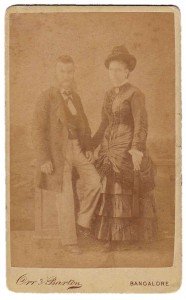
The photograph (top left) where my grand-uncle stands next to my grand-aunt Mira dressed in western attire made of velvet, was taken in 1927 in Patna or Calcutta (now Kolkata).
Around five years later in 1931/32, my grandmother Ira Dutt (now Ray) who was three or four years old was photographed in Patna wearing her brother’s outfit (top right).
It is possible that the original outfit either ran its course, or was given away to other family members, because in 1956 my aunt Anjana Shome (nee Ray) age six, was photographed in Calcutta, wearing a new Scottish outfit bought at The Kilt Shop, on 36 Chambers Street in Edinburgh, Scotland (bottom left). The attire still bears its label.
I myself am wearing that same outfit in the living room of our family home, in Calcutta taken in 1986-87, though my family stopped sending their children to photography studios just for this purpose. My sister Namrata Ray Goyes too wore the same outfit at a fancy dress event at the Calcutta club that same year.
And then when my niece was born, we knew that once she was old enough, we wanted a picture of her in it. So we fished it out of the cupboard and discovered that 30 years on, it was now slightly moth eaten – the jacket was long lost, the socks had holes, and it smelt musty.
Nonetheless, we carefully hand washed and sanitised the garment and had her wear it for a photograph. When I showed these old photographs to my niece, I asked her to copy the pose from any of the images and she chose the one with her great grand-mother, my grandmother Ira. It sure felt great to carry on with a tradition that began almost a century ago.
The common link through these pictures is of course my grandmother Ira (top right), whom we called Ammu. She was the one who had me and my sister wear the dress in the 80s, and it seems in line with the kind of person she was – strong willed, occasionally bossy, with a terrific sense of humour. Front and centre at all family gatherings, she was the glue that held all sides of our family together, until her death in 1989.
In a way I think of this series of pictures as just that – an ode to her, still holding the family together by instating in the process- a subconscious and bizarre tradition of Bengali children in Scottish nuances.