
Image and Narrative points contributed by Aruna Bahuguna (IPS), Hyderabad, Telangana
IMP Research Intern : Aayushi Gupta, Jindal School of Art & Architecture
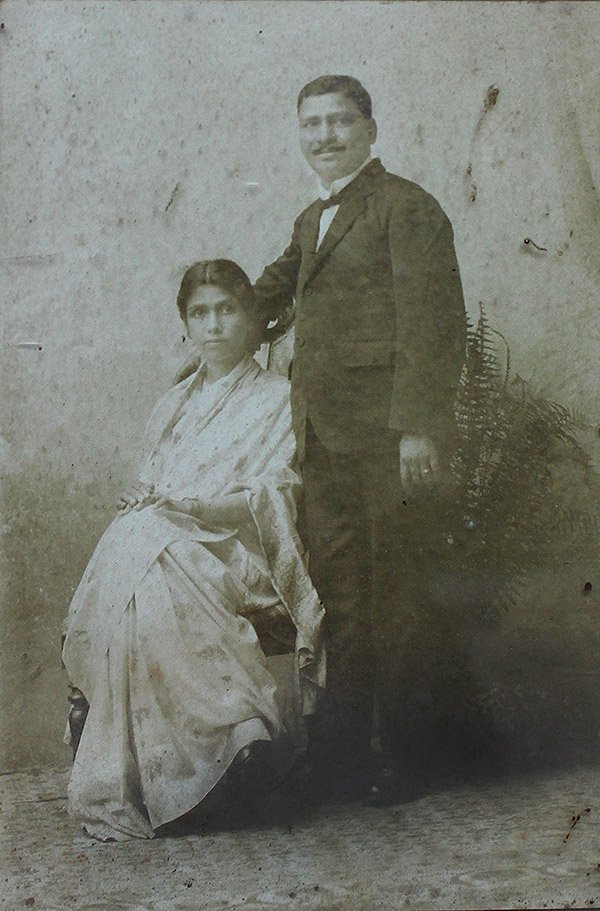
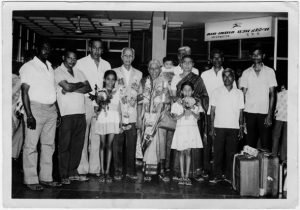
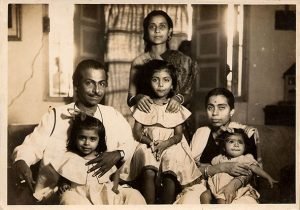
The lady you see in this photograph is my grandmother. She was born as Constance Karuna Charles to an affluent family in Mysore state, southern India, in the in the late 1890s. Around 1910, when she may have been about 12, her marriage was arranged with a man named Durraswamy around 1910. Two years later at the age of 14 she was left widowed, with one baby son in her arms – Arthur.
Constance, my grandmother, was from a liberal family who encouraged her to complete her education at the Maharani College of Mysore and then her father decided to send her to study at University of Oxford. But the prerequisite at the time for studying English literature at Oxford was to know Greek and Latin because classical languages were considered fundamental to a European education. So my grandmother studied to become fluent in Greek and Latin and then she took up English Literature and History at Oxford. A few of her classmates were acclaimed historian Arnold Toynbee, and Nawab Ali Yawar Jung, who became a diplomat, a Vice Chancellor of Osmania University (Late 1940s) and a governor of Maharashtra in the 1970s.
When World War 1 broke out, my grandmother Constance returned home to Mysore in 1915 and began teaching at the Maharani College of Mysore. My grandmother may have accomplished impossible feats, but Mysore certainly hadn’t changed for it. She still had to wear her ‘widowhood’ – a white saree, and it was a bad omen for people to see her face, a face of a widow, in the morning. To avoid causing any discomfort my grandmother chose to live away from the main town and would do all her errands, including plucking ripe summer Mangoes from the few trees close by, before dawn so that no one could see her. Apparently, one morning when it was still dark, a few men saw her plucking mangoes in her white saree and mistook her for a ghost. Then onward, nobody travelled on that road until it was bright enough.
A year or so after, the Nobel Laureate and polymath Rabindranath Tagore visited the Maharani College and was exceedingly impressed by Constance, the young widow, who was raising a son by herself. He immediately offered her a position to teach at Shantiniketan, however, Constance was deeply rooted in the South Indian culture and politely declined. When Tagore travelled from Mysore to Hyderabad, the seventh and the last Nizam of Hyderabad, Mir Osman Ali Khan, discussed his vision of propagating education for women, and Tagore instantly recommended Constance for the job.
The Nizam sent my grandmother a job offer and an invitation to move to Hyderabad and this time Constance graciously accepted. She embarked upon a tutoring program to educate women that included the Nizam’s daughter-in-laws Princess Nilufer Hanimsultan and Princess Dürrüşehvar whom she taught Greek, Latin and History, at the Hillfort Palace (now Ritz Hotel). The princesses became close with my grandmother and would often exchange letters with her.
In the early 1920s, Constance remarried. Her match was arranged with a man who would become my grandfather, Prakash Rao Gibbs, a widower from the Kadappa region in Andhra who worked at the famous DBR (Dewan Bahadur Ramgopal) Mills in Hyderabad. Her wedding saree was a gift from Princess Nilufer. Constance and Gibbs had a son, my father, Andrew Prakash Rao Gibbs.
In the late 1920s, Constance played a pivotal role in setting up the Koti Women’s College, later known as the Osmania University College for Women and now as the Telangana Mahila Viswavidyalayam. She became the first Indian acting principal of the university, until she retired in 1950 and became a member of the Osmania University Senate. Her brother Victor Charles worked at the printing press in the Residency and was closely involved with the visit of the Mountbatten’s to Hyderabad. Having become fond of Tennis in England, Constance also became the life member and life secretary of the Lady Hydari Club, the first only women’s club in Asia for sports (specifically tennis) and socialising. She attended the Eleanor Roosevelt address at the Club as a part of a conference. My grandmother was also the founder of the Poetry Society of Hyderabad, in 1925, of which I am now the president.
After the untimely death of my grandfatherPrakash Rao Gibbs in the 1930s, Constance decided to send both her sons to Bishop’s Cotton School in Bangalore, since she was wary of the overt influence of the Hyderabadi culture on them. Unfortunately, Arthur, her son from the first marriage, lost his life in an accident when he fell while swinging from a tree branch. My father Andrew Prakash Rao Gibbs grew up to become an IAS officer in the 1950s with contemporaries like Abid Hussain, B.P.R Vitthal, Rao Saheb Deshmukh and B.N. Raman. Later he married my mother Irene Nirmala Singh, who was a Journalist from the University of Syracuse, in 1952.
My grandmother remained fiercely independent and disciplined. She was careful with her money and was a strict parent. She paid for and had a home built for herself in Himayat Nagar, despite the several invitations by Mehdi Nawaz Jung, known as the first resident of the famous Banjara Hills, to move to the hills instead. When my father began to earn, she had him pay her rent for staying in her house. Over the years, her dignified personality, an impressive reputation won her some wonderful friendships – for instance the former Prime minister of India, Late.P. V. Narsimha Rao was her neighbour and friend, and his children too were taught by my grandmother. She was close to Sarojini Naidu (nee Chattopadhyay) and her parents. Sarojni Naidu taught my father to sing and would direct plays that my parents would perform in the Lady Hydari Club.
After her retirement in 1950, my grandmother began tutoring children in the verandah of her house. This initiative grew into the Karuna Garden School, commonly known as the Gibbs School, Hadikar Bagh. My grandmother was a strong willed woman who believed in the power of education. She believed that education wasn’t to be monetised and barely charged the students of the Gibbs School. In fact, she would give away books, pens and notebooks for free.
I got to know my grandmother a lot more while my father worked in the districts of the Marathwada region, and my sister and I were brought up by her in Hyderabad. Despite the grand life she experienced, my grandmother never encouraged a highly materialistic life. Once at a party in Rome when she was asked where her jewels were, she beckoned her two sons and said “Here are my jewels”. She instilled in us the power of confidence and independence and we both knew at a very young age that we were going to be working women. Perhaps it is because of Constance, my incredible grandmother, that my sister Karuna Pillai became the Chief Postmaster general, and I, the first woman Indian Police officer of Andhra Pradesh.
3 Responses
It’s very interesting to know about such strong and brave women. They have not only taken the challenges to their stride but have handled them well. It’s nice to know Aruna Bahuguna’s family trail.
WOW. What a powerful and inspiring story of Constance karuna Charles. A truly remarkable lady who coveted the right to shape her own destiny and who helped chart the lives of her progeny . I was moved by her personal sense of renewal , when she returned to her roots in Mysore state but accepted Hyderabad as her second home. Only the giants among us face reality, that which is, but dream of a reality that ought to be and set out to make what must be.despite many centuries of hardened attitudes and narrowing possibilities. She understood that her self interest and her family’s mutual interest ‘s are inextricably woven together.
I had the honor of meeting Aruna Bahuguna , a spirited lady who carved out a successful career in the IPS cadre and garnered immense respect from everyone who knew her,.until she retired from active service recently. She is a close friend of my sister Praveena who is needless to say , mighty proud of her. accomplishments and strong character . A fantastic family that not only did what was pleasurably right but compellingly wise.
Very interesting indeed.Feels so good to read about such brave, strong women.