
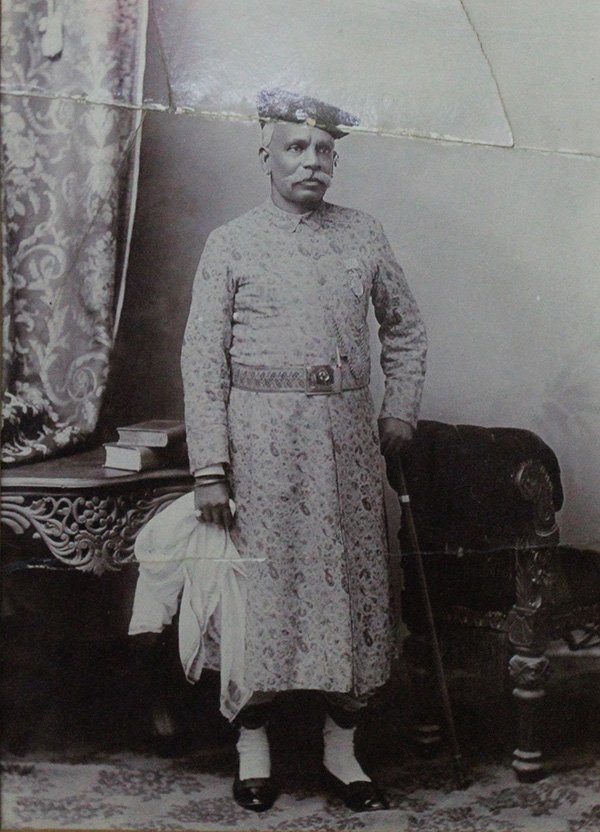
Image and Narrative points contributed by Bharat Malani, Hyderabad
IMP Research Intern : Aayushi Gupta, Jindal School of Art & Architecture
This is a picture of my paternal ancestor, Seth Ram Gopal Malani, most likely taken at his residence, in the late 1890s, or early 1900s. We conjecture that this photograph was taken by the Raja Deendayal and Sons studio like most of the pictures within our family from this time. Seth Ram Gopal Malani, is holding a shawl in one hand and a cane in the other. His turban is tied in the Nagauri style (from Nagaur district, now in Rajasthan) to denote the origins of his ancestry. He is wearing the sherwani made Jamawar fabric from Kashmir, and has a bagaloos (a waist band) tied around his waist. A medal above his pocket and the aiguillette denote his rank as Rai Bahadur and the Dewan Bahadur by the British government – titles that were awarded to him for his philanthropy. It is possible that the prefix ‘Seth’ too was added to denote the affluence he had gathered as a merchant.
But life was more modest for Seth Ram Gopal Malani when he was born in c.1850 as the youngest child in a family of four brothers. His ancestors originally belonged to Nagaur, (now in Rajasthan) and had migrated to Latur (now in Maharashtra) about three centuries ago, and then to the Hyderabad region about 175 years ago. As a young adult, he lived in present day Alwal, close to Hyderabad. At the time, pilgrims would exchange larger sums of money for fractional coins and the small coin traders would keep a small percentage as the cost of transaction. And so my ancestor Seth Ram Gopal Malani too would walk to the General Bazaar every morning to sell chillar (fractional coins commonly known as change) to people on their way to visit pilgrimages.
Every morning, before setting out to work, he would pray to the idols of Lord Jagannath placed under a tree in the akhara, a place of practice with facilities for boarding, lodging and training. Apparently every night he dreamt of Lord Jagannath asking for a temple. Seth Ram Gopal would chuckle about how he barely had enough to eat, yet the gods expected him to make a temple! One day in his dream, Lord Jagannath asked him to pledge the temple when he had enough money, and Seth Ram Gopal conceded, unaware of what the future held for him.
At the time, a British resident, who lived at the Residency House, Secunderabad (present day Rashtrapati Nilayam, Bollaram) would watch Seth Ram Gopal walk the 10-plus-kilometer distance every day to trade coins and one day decided to offer him a lift in his carriage. Soon this became a daily gesture, where the British resident would pick the young man on the way and drop him to General Bazaar. As they got friendlier, the resident mentioned that they needed some repair work at the Residency House and Seth Ram Gopal immediately took up the task. This proved to be a turning point in his life, because soon enough he was a building contractor who went on to become one of the biggest contractors of the Nizam Era – working on developing Gandipet, the Mint Compound, the Railway works, a part of King Kothi Palace, a part of Falaknuma palace, and eventually he helped build not just one, but many temples.
The first temple he helped build was the Jagannath Temple in the General Bazaar, where an engraved turtle in the former Akhara is still intact. The Rath yatra procession from this temple is the third largest in India. Seth Ram Gopal went on to build more temples, namely – Hanuman Temple in Lower Tank Bund Hyderabad, and the Sakshi Gopal temple close to Puri. When on a trip to Mathura, he was refused a place in the local dharamshala (a shelter for pilgrims), he built his own dharamshala and subsequently owned dharamshalas in Mathura, Vijayawada, Baasar and Ayodhya. Seth Ram Malani possessed great humility and developed a generosity that is rarely seen or heard of nowadays. He sponsored many pilgrim’s trips to the holy temple of Jagannath Puri, funded a skill development centre, a home for the aged, the Medak Cathedral and the belfry of St. John’s Church.
To develop the infrastructure in Hyderabad, he set up the renowned DBR mills on the Lower Tank Bund Road, and the oil and cotton mills in Nizamabad, Hansa, Sailum, and Warangal. Once on a visit to the Nathdwara Temple, near Udaipur, he discovered that the offerings to the god couldn’t reach the temple because of a flood at the Banas River, and so he got a bridge constructed on the river with the blessings of the head priest and Maharaja Fateh Singh of Udaipur, that is in use even today..
Salarjung III, a nobleman and art collector who served as Prime Minister of Hyderabad Deccan during the reign of the 7th Nizam, Mir Osman Ali Khan, was a director in the DBR mills and would often borrow money from Seth Ram Gopal, even if he didn’t need it. When he was asked why he did so, Salarjung III explained that every time the Nizam asked him for money, he could conveniently say “My Lord, I myself am a debtor of Seth Malani!” without having to give a single paisa to or having to lie to the king.
Seth Ram Gopal was one of the few people who received mangoes from the Nizam, that would unfortunately turn rotten by the time they reached him, but it was customary that he present the Nizam with the regular Nazrana, fee for land ownership, proportionate to the number of mangoes he had received. The Nizam of Hyderabad announced a part of James Street to be known as RamGopalpet where a statue of my ancestor stands.
Seth Ram Gopal Malani was married to Rukma Bai and lived in a mansion on the former James Street (now MG Road, Secunderabad). He adopted Laksmi Narayanji Malani as his son who took his legacy of philanthropy forward. Laksmi Narayanji funded the James Street Arch, a commemorative monument of Prince Edward’s visit to Hyderabad, and the clock tower of Secunderabad. He even built an airfield in 200 acres of the family land in Warangal and contributed to World War II efforts in the form of war bonds. Lakshmi Narayanji’s knighthood had been approved, however, he passed away days before he could receive it and did not receive it posthumously.
Seth Ram Gopal began his life as a modest man of modest means, and he became a modest man of great means who devoted his life to his work, his worship, and for the betterment of people. As his descendants, we hold his legacy and generosity with great respect and pride.

CONTRIBUTE YOUR OWN STORY : Every family in this amazing subcontinent has at least one photograph that carries with it a memory of past generations – and at the very least it holds stories that evoke wonder, adventure and pride. Indian Memory Project invites you to be part of one of the most loved archives in the world – please send us a story about your family – and if you need any help writing it, do not hesitate to get in touch. The submission link is here, and alternatively, you can write us at hello@indianmemoryproject.com
If you like the project, admire it, and benefit from its knowledge, please consider awarding us an honorarium to make the future of this project robust and assured.