
Image and Narrative contributed by Anupam Mukerji, Mumbai
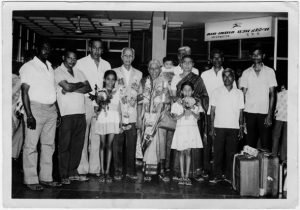
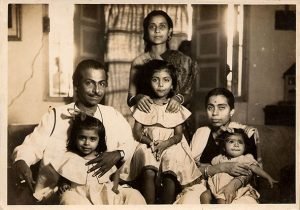
This picture was photographed on March 9, 1970 on the occasion of my maternal grandparents Kali Pada and Sukriti Chakrabertti’s 25th marriage anniversary (seated middle), at their home, 63, PG Hossain Shah Road, Jadavpur, Calcutta (now Kolkata). Here, they are with their daughters Sarbari, Bansari and Kajori, their son Sovan, and several nephews and nieces.
After graduating from school with a gold medal in East Bengal‘s Dhaka Bickrampore Bhagyakul district, the young teenager, Kali Pada Chakraberti moved to Calcutta. He began working while continuing his education in an evening college. The office he worked at was also his shelter for the night. Desperate for money to pay his college examination fees, he went to a pawn-shop in Calcutta’s Bow Bazaar to sell his gold medal.
The pawn broker at the shop however was a gentle and generous elderly man. He lent my grandfather the money without mortgaging the gold medal. Years later when my grandfather went back to the shop to return the money, he found that his benefactor had passed away and his son refused to accept the money stating he couldn’t, because his father had left no records of that loan. My grandfather then established a Trust with that money to help underprivileged students with their education.
Bhai, as all his grandchildren fondly called him, graduated from college with distinction and built a successful career in the field of Insurance. He rose to a senior position in a public sector insurance company. He also bought a plot of land in Jadavpur and built the house of his dreams where this photograph was taken. Post partition of Bengal, many of his family members moved to Calcutta and everyone found food on the table and a roof over their heads at his house. Over time, many of them moved out and made their own homes, but 63 PGHS remained the place where everyone congregated for festivals and special occasions.
Sukriti Chakrabertti, my grandmother, was fondly known as Hashu Di. She was raised in Shanti Niketan and learnt Arts & Dance under the guidance of Gurudev Rabindra Nath Tagore and Nandlal Bose. She was part of the first batch of students of Shanti Niketan’s Kala Bhavan and went on to make a name for herself in various classical dance forms.
In love with each other till their last day, they passed away in 2000 and 2001, within three months of each other.
6 Responses
Hashu Masi as we called Sukriti was a very close friend of our mother Anima /Mini. We visited their place in Jadavpur.
Only last year I came to know from Anu Masi’s daughter that Shobhon has left us.. with a hurry.He was so affectionate. Few years earlier we accidentally met in Santiniketan when he visited Abhijit Dasgupta’s place.
Sobhon’s uncle, Hashu Masi’s brother Tinu da was very close to our family.His death was terribly tragic.
To be from the first batch of Shanti Niketan must be really great.
That pawn broker was a saint in disguise.
Touching!
lovely!
This is beautiful