

Image and Text contributed by Peter Curbishley, United Kingdom
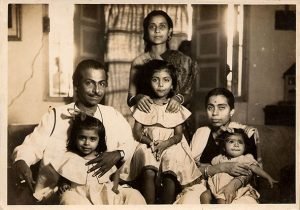
This is an image of British soldiers, their wives and friends from 1/1st Kent Cyclists Battalion taken sometime between 1915 and 1919. They were at posted in Bangalore, Dalhousi, Deolali, Bombay, and then later at Lahore and Rawalpindi (now Pakistan). The sergeant sitting on the right is my grandfather A/S S.L Stonely. The image may have been photographed in Dalhousie before their posting to or from Rawalpindi. Dalhousie was a quaint hill station established in 1854 by the British Empire in India as a summer retreat for its troops and bureaucrats. Unfortunately, I do not know much about this image and I found it in a bunch of negatives sitting in an old box for years. Only recently I decided to get them digitised. It seems that several of these images were photographed by my grandfather, because the records show that Kent Cyclists Battalion had a Camera Club.
All I know is that my grandfather was a member of one of the Kent Cyclists Battalions which was formed before World War I. Upon being removed from regimental strength, in 1908, the Queen’s Own Regiment of cyclist soldiers was re-named as the Kent Cyclist Battalion, and at that time became the Army Troops attached to the Home Counties Division (Territorial Force). The military use of cycles had begun in the 1880’s when a number of the old volunteer battalions had set up Cyclist Sections, whose brief was to defend Great Britain in the advent of an invasion, being something akin to a part time rapid response unit. In 1915, the first units of the Army Cyclist Corps went to serve overseas, including India and were serving primarily in reconnaissance roles – as Dispatch Riders, engaged on traffic directing duties and also assisting in locating stragglers and wounded personnel on various battlefields.
The Battalion served very well, albeit for a very short while. The bicycle had not long ago been invented and originally was thought to be a good way to get soldiers to move around, but the cyclists often found themselves attempting to negotiate unfriendly terrain, and on numerous occasions were forced to abandon their heavy army issue bicycles. On rough terrains such as India’s they would get stuck in the mud and not much of use. With little future value, eventually, all Cyclists Battalions were disbanded in 1920. However, of all the various English, Scottish, and Welsh battalions that served during the Great War years, the 1st/1st Kent Cyclist Battalion was the sole battalion to be awarded battle honours. They were converted to infantry and used instead for foreign services in India.