
Image and Narrative contributed by Jayati Gupta, India
Indian textiles were a major part of the East India Company’s trade since the 17th century. Hundreds of thousands of people in India were involved in the textile trade, as spinners, weavers and dyers. By the early years of the 20th century too, textile and textile technology was controlled and promoted by the British and colonial masters. Indian textiles was a rapidly growing industry, especially since the demand for British cotton had slumped during the interwar period.
During the booming era of the East India Company, raw materials were sent back to Britain and the finished goods were re-exported and sold in the colonies at exorbitant prices. The production and consumptions of textiles was controlled with imbalanced equations between the producer and the consumer, the coloniser and the colonised. When Mahatma Gandhi’s activism to promote khadi (homespun thread and home-woven cloth) became a big part of resistance to imperial authority, cotton became an important symbol in Indian independence and the Swadeshi movement began to overrule all. The resistance took the form of boycotting foreign goods and textiles.
My father, Nirmal Chandra Ghosh (1911-1989), after his initial education in the Zilla School (district scool) in Hazaribagh, Jharkhand, (formerly part of Bihar), won a scholarship and decided to train as a textile technologist.
In 1930, he became a student of Victoria Jubilee Technical Institute (now Veermata Jeejabai Technical Institute/VJTI) in Matunga, Bombay (now Mumbai). He graduated in 1934 becoming that year’s recipient of the Dadabhai Nowrojee Gold Medal. His name appears on the Roll of Honour, a board that is maintained in the Institute. Those were heady days of the nationalist movement and my father was very far away from home living in a cosmopolitan city thriving with conversations on the movement. At the time, for such distances from Bombay to Jharkhand, a railway journey would take more than three days, letters reached after more than a week and telephone calls were unheard of.
My grand father Kshitish Chandra Ghosh, was employed as a Post Master in the Bihar Postal Service run by the State & British administrators. It was a transferable job and he had warned his children, a large family of four sons and five daughters, that any nationalist activity they indulged in could be interpreted as anti-government and lead to losing his job. He sternly indicated that any anti-government activity would have disastrous consequences for the family as he was then the sole earning member and hence they would have to be very cautious.
But my father, at the time a young man in Bombay, was inspired by the movement of resistance and found a way to express himself. In his final year (1933-34) one of the assignments that he had, was to design and weave a piece of cloth. Very ingeniously he wove several textile portraits of public and national figures, highly respected and feted by patriotic countrymen. He wove portraits of Raja Ram Mohan Roy, the Father of the Bengal Renaissance, of Rabindranath Tagore, Poet & Nobel prize winner and of Mahatma Gandhi, already an icon of Indian nationalism. One of those portraits woven of Raja Ram Mohan Roy by my father, as shown in the photograph, was framed many years later and still hangs in my sister’s Kolkata home. As a child, I remember the woven portrait of Gandhi hanging in my grandmother’s room in Hazaribagh. The other portraits may have been gifted by him to others and seem to be lost.
Luckily, this gesture expressing solidarity with the national movement went unrecorded and unnoticed by his sahib instructors. My father spoke of the act as an inspired passive resistance, and that it was a source of immense thrill and excitement when he was planning and executing the design. In volatile colonial times, it must have needed immense personal courage and extreme conviction to think and act in this manner.
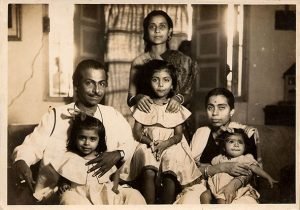
My father was also an excellent amateur photographer. The image above was photographed and pasted by him in his album. The album also holds photographs from early to late 1930s from the time of his education in Bombay to when he lived in South India on his first and only job with A &F Harvey Limited, established in 1883 by two Scottish entrepreneurs. A & F Harvey Ltd., a british company, was incorporated as a private limited company in 1945 to manage textile and other companies in South India. It acted as the Management Agents of Madura Mills Co., Ltd., until December 1969. My father retired from his job in 1970.