

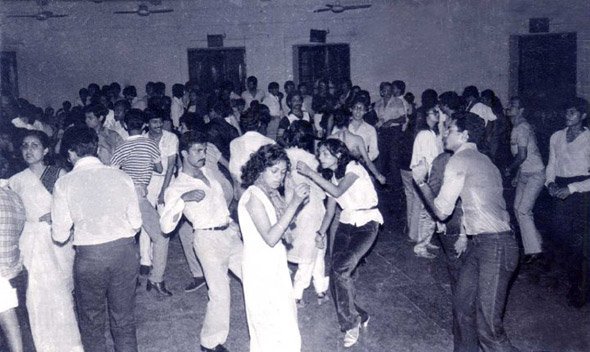
Image and Narrative contributed by Charu Walikhanna, New Delhi
This was a hot day with a baking hot floor. I was in 4th yr of Sir JJ School of Applied Art. And the same campus housed disciplines of Fine Arts, Textiles and Interior Designing. This dance party was an event organised by JJ School of Architecture during their annual festival SAAWAN. The dance party in the image was not in our campus but in a hall in Colaba. I wonder if it still exists.
We used to then dance like mad, to songs of ABBA and other such English bands. There was no Punjabi rock or rap in those days and there were definitely no intoxicants or alcohol. Nor did anyone have bottles stashed away in their car like today in Delhi. Some people were into soft drugs though no one ever experimented openly and definitely not at college functions. We lived, ate and dreamed of Art & Design. Our heroes were Picasso, Salvador Dali and Charles Correa. We were so absorbed in our passions, that failure or success was not the ultimate goal. A well known joke was that if one failed at JJ and was yet successful, it may be better because Charles Correa, one of India’s most famous architect was JJ drop-out too. In those days, film stars like Parveen Babi flocked to our college to hear J Krishnamurti’s lectures on Philosophy, on campus under the huge banyan tree while the sun set and the crows cawed.
I was a boarder in Bombay. JJ did not have a girls hostel so we girls stayed at a government hostel called the Women Students Hostel. The Hostel was started by the Government of Maharashtra in 1952, to accommodate undergraduate girl students of colleges affiliated to the University of Mumbai. The hostel was renamed to Savitridevi Phule Mahila Chhatralaya to honour the memory of – Savitridevi Phule, a pioneer in the education of women. The hostel is situated at the beautiful location of Marine Drive facing the Arabian Sea. I have an aunt who stayed in the same hostel in the 50s and said they were served by waiters in turbans, though by our time it only had bare-feet locals in striped underpants. The dining hall was the only place men were allowed and only as waiters.
5 Responses
I don’t think the party dancing has changed much after 30 years. We still dance the way people are danicng in the pic after 2 pegs. :)
Lovely. Brings back memories of the Bombay of the seventies and eighties. I am surprised that these pics are now considered old :-) But then time and tide wait for none.
Hey..
I am an alum of Sir J J College of Architecture (as it is called now) and would love to share this picture and the story associated with it with my friends and professors from the same institution. Would you mind if I posted the URL on my facebook account?
Thank you Ashwin, Please do help spread the word so we get more pictures and more stories :)
And a wonderful story to go with the picture… this site gets better by the photograph!