

Image and Narrative contributed by Janet MacLeod Trotter, UK
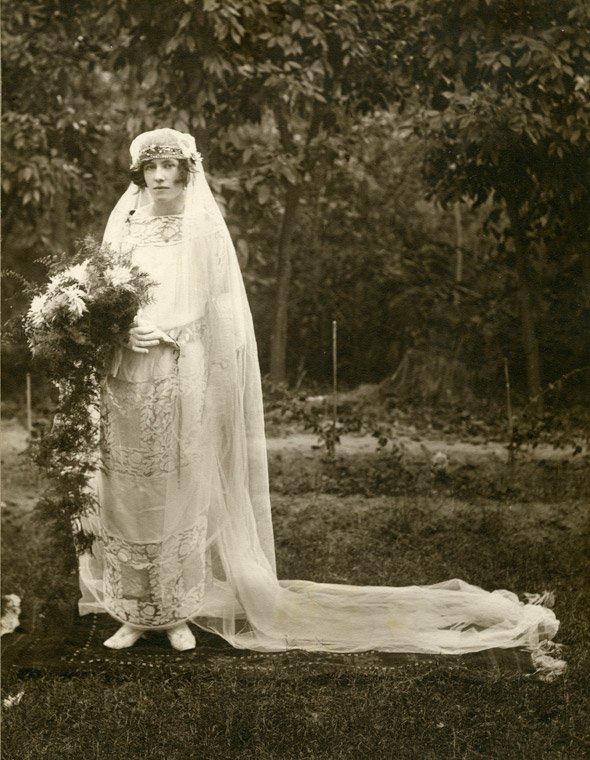
This is a photo of my Scottish maternal grandmother, Sydney Gorrie (nee Easterbrook) on her wedding day in December 1923. She and my grandfather, Robert Gorrie, were married in a cathedral in Lahore (now Pakistan). She looks beautiful but perhaps to me, also slightly apprehensive. This may be because she hadn’t seen her fiancé in over a year and had just travelled out by ship with her parents from Edinburgh, Scotland to get married. For some time their home was in Lahore (now Pakistan) which my grandmother enjoyed.
Robert Gorrie fondly called Bob, a veteran of the World War I and survivor of trench warfare, had secured a job with the Indian Forestry Service, as a conservator of forests. Sydney was an only child and had left behind home and extended family in Edinburgh, Scotland for an unknown future trekking around the Himalayan foothills with her new husband. Bob was enthusiastic about trees and conservation and became an expert on soil erosion. He worked all over Punjab and the remote foothills of the Himalayas, and my grandmother would have to plan and organise camping trips for a month or so at a time.
When my mother was born, she was taken along too; her pram hoisted onto poles and carried along jungle paths. According to his Work Records, Scottish Bob was “a tiger for work” but was impatient with the bureaucracy and criticised for being outspoken. My granny would sigh that she was constantly having to ‘smooth the ruffled feathers’ of the administrators. He was also based at the forestry college in Dehradun (now Uttarakhand) where he taught and also where their second son, my uncle, Donald was born. I think he was more popular with the students as some of them kept in touch with him until much later in life.
Before World War II broke out, granny’s father’s illness had her visit home in Edinburgh. My mother and her two brothers went to school back in Scotland, and were looked after by grandparents and lots of doting aunties! Bob stayed back in India, and did not see his family for over six years, and after Partition he worked for the new Pakistan government for a while.
In retirement in Edinburgh, my brothers and I used to love visiting their house – we would join Granddad for early morning yoga kind of exercises in the sitting-room. He would point to a picture on the wall of a grinning man in a large hat and say it was of him eating porridge in India. It was only years later I discovered it was a copy from a Degas painting of a farmer drinking from a bowl of soup!
My grandparents’ stories were the inspiration for my own trip to India. When I was 18, I went overland in a bus to Kathmandu via Pakistan and India. In Lahore I sent my granny a postcard (my grandfather has passed away by then). What I didn’t know was that she had had a stroke and was in the hospital. The last time my mother saw her alive was the day my postcard arrived. She was able to read it to Granny, and although she couldn’t speak in reply, she knew that I had got there. I, on the other hand grew up to become an author and wrote a mystery novel based on my overland trip in the 1970s, called The Vanishing of Ruth.
2 Responses
Since researching my family have discovered over 200yrs of history there. my Scots side arrives in 1817 & the other from somewhere in Gt Britain before 1840 I have yet to trace. Another line goes back into the 1700s and the East India company. How I would one day like to write their stories – but at the moment there are too many gaps and no first hand information. Enjoyed you grandma’s story.
I fouhd this very interesting i am a great admirer of your books and i am now reading The Tea Planters Daughter,thank you. Raymond Annies.