
Image & Narrative contributed by Rohit Kulkarni, Pune
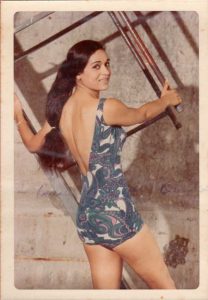
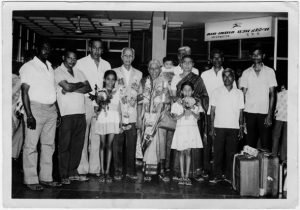
This is a photograph of my grandmother, Jaya Phatak. It was taken at a film studio in London in 1972.
My grandmother was born in the Phatak family in Pune, Maharashtra in 1926. Her father Duttatre Phatak worked with the British Indian Railways, and was also the manager of a record label ‘Orion‘ that no longer exists. I am told he was instrumental in the first ever recording of Ustad Abdul Karim Khan, a well-known Hindustani Classical Singer and appointed musician to two royal courts in Baroda, and Mysore. Duttatre died when my grandmother was very young and over time her life turned out to be very different for many of the women of her era. She was very interested in sports and also represented the State at the Kabaddi Nationals in 1964.
She was very young in 1942, when she became involved in India’s Independence movement in Pune. She was jailed along with other 6-7 of her mates and sent to Yerwada Jail for disrupting and distributing Anti-British leaflets at a British military gathering at Nowrosjee Wadia College grounds. At the jail, she discovered many more imprisoned freedom fighters across castes and classes. They were detained and went through a one-month trial, and offered either Bail or an arrest for a month in jail. The family didn’t have much money so there was no bail forthcoming. Despite an arrest for only a month, my grandmother says that they were still not released and instead were kept for another 11 months, because British law stated that it did not need to justify or give reasons to detain anyone. She notes that in prison, despite the fact that everyone was fighting for the same cause, a section of the higher caste would not share their meals with other castes. There was unsaid segregation along caste lines and at that time, caste lines were not questioned very much.
My grandmother was married twice. After divorcing her first husband which was unheard of at the time, she met and married my grandfather Vishwanath Modak, a journalist, who ran a daily political /social commentary column in the Marathi newspaper Prabhat and they fell in love. My grandfather used to call my grandmother “the man amongst the women”. She was fiery, opinionated and an atheist. My mother is the only child they had and jokes that her birth was an experiment that was never to repeated again.
My grandmother Jaya found a good job at the Department of Education and was sent to England in 1972, to study and receive a Diploma in Production for Films – for education specifically. This picture is from that time when she was studying there. She also established a charitable trust called Kishor Mitra (“friend of the young”) where she produced short films on simple science – for instance how a Thermos or bread is made and helped publish Marathi books for making learning fun. Inspired by Sesame Street, the well known American Television series for children, she developed and produced puppet shows that were made into educational films. It was her first and last job until retirement. My grandmother Jaya continues to be a trustee of Kishor Mitra and lives in Pune with her granddaughter.
One Response
I want to see a current picture of the grandma too!