
IMP Research Intern : Priyanka Balwant Kale, Pune
Image and Narrative Points contributed by Sumedha Deshmukh, Pune
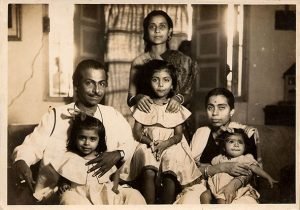
The above photograph is of my parents, Rajaram and Annapurna Telang, taken in Urun-Islampur (Islampur for short, in Sangli District) Maharashtra, in 1956. The image below shows my older siblings, Ramesh and Snehlata, photographed in 1955 when they were two and five years old. My father Rajaram or Appaji, as we would call him, had learnt photography and would paint on his prints often. Appaji served as a bank employee throughout his life, and was a perfectionist when it came to his creative interests.
My parents’ families were originally from a village in Hyderabad State (now in Telangana state) called Manthani, Peddapalli district, on the banks of river Godavari. It had a unique composition with the majority of the population of Brahmin caste and a minority trader community called Komati living together in complete harmony. Our last name at the time was Yellishetty, still used among our relatives.
With fewer options of employment in his village as well as deeply felt discrimination by a rather tyrannical attitude of the Nizam Shah, my grandfather along with his family migrated to Karad (originally known as “Karhatak or”Elephant Market”), Bombay Presidency (now Maharashtra state) via the Hyderabad-Nanded (Marathwad) route in 1915. Marathwad, was part of the then Hyderabad State and a nodal point between Marathi and Telugu culture. Fearing exclusion from the nearby village communities for being dark-skinned South Indians, even if from a village of Brahmins. My grandfather adopted the last name ‘Telang’ to reinforce the family’s upper caste status, and received a land-grant in the vicinity of a temple for cultivation.
My Appaji was born in 1924 and brought up in Karad. He later moved to Poona (now Pune) for a university education at the Brihan Maharashtra College of Commerce (BMCC) where he earned a degree in Commerce and was cleared for Banking Examinations. After his father’s death, he returned to Karad and got a job at the Karad Urban Co-Operative Bank in 1943. The bank was at first established first as a co-operative credit society in the year 1917 and was subsequently converted into a bank. My mother, Annapurna was born in 1934 and also brought up in our ancestral Manthani village. In 1943, her match was arranged with my 19 year old father when she was only nine years old.
My father was transferred frequently to small bank branch locations within the state like Pareli, Islampur, Aurangabad and Jalna. Since there weren’t many opportunities for entertainment and he had enough time at his disposal post work, Appaji developed several sincere interests, that he would research and study in detail. While in Aurangabad, he developed an interest in bird-watching because of the Salim Ali Lake & Bird Sanctuary, named after the Birdman of India, ornithologist and naturalist Dr. Salim Ali. Like Dr. Ali, my father too, photographed and painted birds. In Islampur, when my elder siblings were born, he developed an interest in photography, developing prints and hand painting them.
While my father was an all-rounder, you couldn’t find a brave woman like my mother Annapurna. My mother’s family were from the Muddu community and were well educated as well as influential people. One of her brothers tutored P.V Narasimha Rao, the former Prime Minister of India and another brother became a Vice-Chancellor of Osmania University. At the time of her marriage, barely nine years old she had only studied up to second standard/grade. She knew no other language other than Tulu, but Appaji taught her to read and write in Marathi because she was now a part of the Marathi-speaking culture as well.
My mother was a rapid learner and grew up into quite a bold woman. She too, like my father, was interested in the pursuit of knowledge and soon discovered that she had a strong and articulate voice. She began participating in local debating competitions and in 1964-65, when the Congress cabinet minister Shankar Rao Rakh was contesting elections in Pareli, she campaigned for him with great enthusiasm and powerful speeches on his behalf.
Owing to their origins in Manthani, where everyone followed strict religious codes, my parents too were quite religious. I remember during summer vacations, we would visit our ancestral home in Manthani, and watch people begin their daily routine by taking a dip in Godavari, attending prayers at the temple and only then being permitted to eat. But after my father secured a job at the Bank of Maharashtra in 1968, and we moved to Pune, following the strict religious code in every context became difficult and my parents relaxed the stringent adherence to many traditions.
For the first four months in Pune, one of our acquaintances offered us a one-room tenement in Guruwar Peth. It was like a chawl- a single building where another Marathi family, and a Gujarati family resided. Ours was at the top floor and everyone in the building had to share one bathroom. For Appaji, a higher position job kept the work-pressure up and he couldn’t find much time for photography. When he was diagnosed with Diabetes he became a life-long member of Diabetes Association of India where he would frequently organise physical fitness activities.
Our family has lived in Pune since 1968, yet we have maintained wonderful relationships with our extended families in Manthani. Historically, Telugu and Marathi communities have shared common ground and have been culturally vibrant – the regional affinities between the modern states of Telangana and Maharashtra are fortunately still intact and our last name ‘Telang’ still holds the memory of the place we once belonged to.
The addition of this Photo-Narrative to the archive has been made possible due to the generous consideration towards Research Internships by Nazar Foundation, New Delhi.
5 Responses
The (language group) Telugus are referred as Telang people by Marathi speakers.
My last name is Telang too. I am a Maharashtrian from Madhya Pradesh. My father and grandfather used to tell me a similar story like yours that our ancestors were Maharashtrians who migrated to Hyderabad State and later, for a better job offer in music field, our great grandfather migrated to Gwalior and later to Kanpur, finally returning to Gwalior again. That’s how my father’s generation settled down in and around Gwalior, precisely Madhya Pradesh.
My maternal side last name is also Telang. I had come across someone’s blog claiming that Telang Brahmins originated from Telangana. Just wondering if you have any more information about the general origin of Telang Brahmins?
I family too originated from Manthani, Peddapalli district, on the banks of river Godavari. My ancestor migrated in mid 17-18 century to Varanasi (Uttar Pradesh).
Sadly, we have lost touch with out ancestral village and people for last 3-4 generations.
Its good to know that you still have strong connections with your ancestral home town.
Thanks
Amitabh
While my father was an all-rounder, you couldn’t find a brave woman like my mother Annapurna. My mother’s family were from the Muddu community and were well educated as well as influential people. One of her brothers tutored P.V Narasimha Rao, the former Prime Minister of India and another brother became a Vice-Chancellor of Osmania University. At the time of her marriage, barely nine years old she had only studied up to second standard/grade. She knew no other language other than Tulu, but Appaji taught her to read and write in Marathi because she was now a part of the Marathi-speaking culture as well.
In the above para, Annapurna knew no other language than Telugu. Not Tulu. Tulu is spoken in parts of Karnataka