Image and Narrative contributed by H.N Anandagiri, Bangalore, Karnataka
My father, H.S. Narasiah, was born on April 14, 1905 in Vepanapalli, a small village near Krishnagiri District (now in Tamil Nadu), but lost his parents at a young age. During his later educational life, two years (1924 – 1926) at the Ramakrishna Mission Students’ Home in Mylapore, Madras (now Chennai) shaped his discipline and a value system for life. He later pursued B.A. at Presidency College and an LLB at Madras Law College (Dr. Ambedkar Government Law College). After completing his studies, he moved to Bangalore (now Bengaluru) and began practising as an advocate, first living in Cubbonpet and later in Halasuru.
My father was deeply motivated by public welfare and wanted to do everything he could to help people. So in 1932, he also took on the role of the General Secretary of the Bangalore Textile Labour Union. He was actively involved in India’s independence struggle, He dressed only in Khadi, lived by Gandhian ideals, and faced imprisonment. He founded several organisations, including The International Order of the Gandhian Brotherhood, where he served as the first Brother. By the early 1940s, be it in circles of law, politics, or spirituality, my father had become a respected public figure in Ulsoor, sought after by civic leaders, regional leaders, and the marginalised alike. His reputation extended to even the illustrious Akhtar Begum of Liberty Theatre sought his legal advice, arriving in her famous Cabriolet Mercedes or white Impala.
From 1939 to 1942, my father served as the Municipal Commissioner of the Civil and Military Station, Bangalore, and from 1945 to 1947 as its Vice President. He also served as a Member of the All India Congress Committee and Mysore Pradesh Congress Committee, and as advisor to the Bangalore City Improvement Trust Board and the Mysore Transport Corporation.
Around 1942, he met Bhagawan Anandagiri, a revered spiritual master from Tamil Nadu and it transformed his life. Swamiji performed his last Chaturmasya (a four-month sacred period to observe increased austerity, prayers, and food restrictions) at Kaadu Malleshwara Temple in Bangalore and he stayed at our house, which he named Chid Akas (“the space of consciousness”). As per my father’s wish, the property later became part of the Bhagawan Anandagiri Trust.
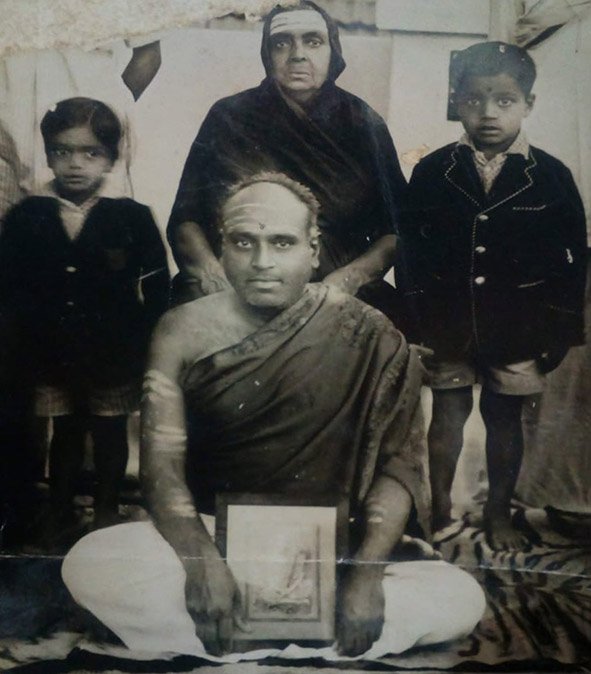
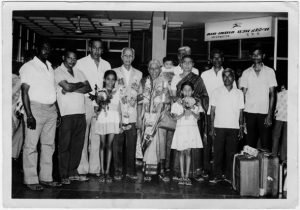
In 1946, my father served as an Additional Public Prosecutor and in 1952, he travelled by ship to Karachi, Pakistan, as part of a team of lawyers. He later published a memoir titled A Bangalore in Pakistan. This photograph of my grandmother Seethamma with my father and my elder half-brothers, H.N. Ramakrishna (left) and H.N Srinivas Anand (right) and was taken around the same time. In this photograph my father is holding an image of his Guru, Bhagawan Anandagiri (Tanjore Swamigal). Later in 1956, he authored a biography of Bhagawan Anandagiri, with a foreword by Sanskrit scholar Devudu Narasimha Sastry. He wrote a Tamil book on the Guru Gita and often discussed Maya, Ego, and the path to Moksha.
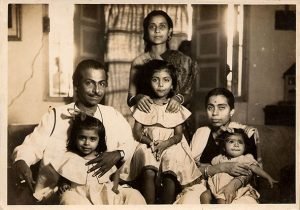
My father’s first wife, Jayamma, had bore two sons and a daughter but passed away when they were young. A year after this photograph was taken, in 1953, he married my mother, Gnanamba, from Lakshmisagara near Chandapura, Bangalore. Together they had three more sons and another daughter. I am the eldest of the four. In total, my father had five sons and two daughters and we all remained a close knit family.
My father observed all Hindu rituals and festivals with devotion. At Deepavali, our home was filled with sweets and cracker boxes, distributed equally to everyone. During the annual Someshwara Car Festival (Halasuru Rathotsava), he helped pull the temple chariot until it was properly parked. His spiritual discipline was such that he performed Sandhyavandanam (a mandatory, thrice-daily Hindu ritual of Gayatri chanting, pranayama, and meditation) even on moving trains, remarking, “If a Muslim can do his Namaz anywhere, I too can perform my rituals.” Every year, he conducted his Guru’s Aradhana for three days: Day 1 (Hanuman Jayanti): hoisting of a Hanuman flag, Day 2: rituals and feeding hundreds of guests, Day 3: a grand procession of Guru Anandagiri’s photo, with Nadaswaram ( a wind instrument) and Vedic chanting through the main streets of Ulsoor. My elder sister, Usha, and her friends would clean and decorate the street with Rangoli.
From 1960 to 1963, he was appointed Government Pleader to both the State and Central governments. In 1972, my father was elected to the Rajya Sabha, where his reputation as one of the most knowledgeable men on Sanatana Dharma (an alternative term for Hinduism) preceded him. His fellow MPs came to him to better understand Hinduism and its relevance to the modern world. Once an admirer of the Nehru family, he grew disillusioned during the Emergency (1975) declared by Indira Gandhi. It upset him enough to insist that none of his children should enter politics. He confided to friends that the Congress had strayed from its original ideals and began considering leaving. However, he passed away on May 15, 1977 at the age of 72, as a sitting Member of Parliament.
Among his children, my elder brother H.N. Srinivas Anand passed away in 2001, sister Usha in 2006, and youngest brother H.N. Harinarayan in 2025. I, H.N. Anandagiri, along with my siblings H.N. Ramakrishna, our sister Uma, and H.N. Dattatreya, carry forward his legacy. To sum up my father’s life in these few words feels inadequate, yet even a brief narrative is essential to honour and celebrate his legacy. He was one of a kind—a towering figure, honest, simple, and deeply committed to society’s welfare. For us, he has left behind not just a name but an honourable way of living.
2 Responses
Excellent and illustrious life led by him. Kudos.
Read the article “An honourable way of living”, that was truly inspiring and showcases the purpose of human life characterised by honesty, dedication and spiritualism reflected in simple but impressive narration by Mr Anandagiri.