
Image and narrative points contributed by Rasika Dugal, with inputs from her father, Jassi Dugal (Maharashtra / Jharkhand)
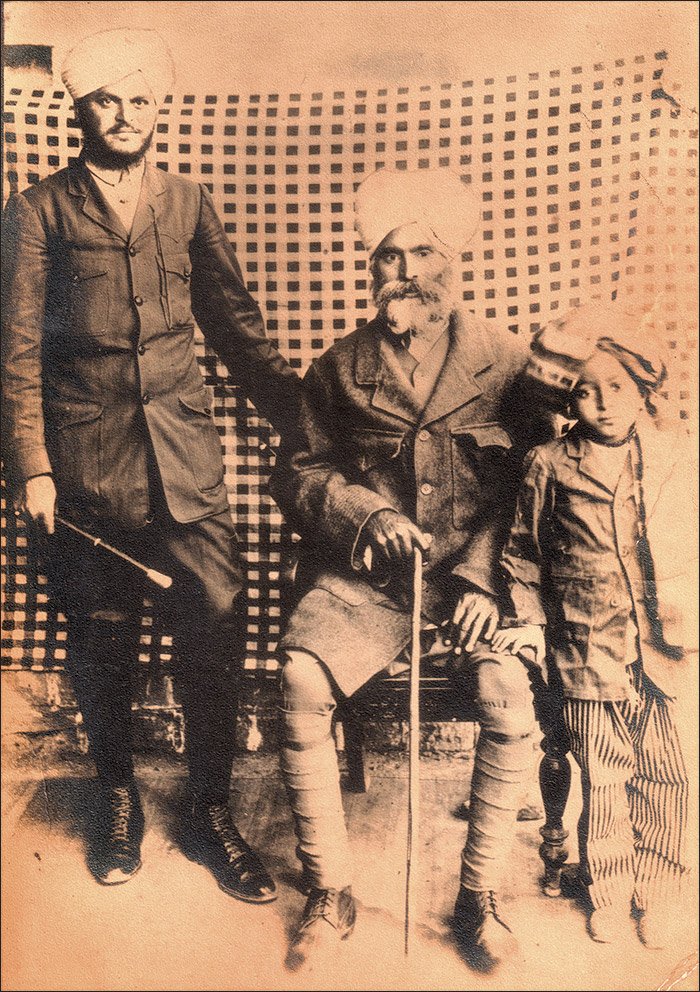
This photograph is probably the oldest in our family photo albums. Taken around 1911, it shows my great-grandfather, Kartar Singh Dugal — whom the family called Bauji — standing on the left. He was about 18–20 years old. His father, my great-great-grandfather, Soba Singh Dugal, a stoic figure, is seated in the middle, and leaning on him from the right is Bauji’s younger brother — around ten years younger — my great-granduncle, Raghubir Singh Dugal. The photograph was most likely taken in Rawalpindi, about 80 km from our ancestral village, Syed Kasran (both now in Pakistan).
Kartar Singh, my great-grandfather (Bauji), the young man on the left — was born around 1887, and the story goes that at the age of 15, he ran away from home and found himself far to the east, 1,600 km away in Calcutta (Bengal Presidency). Why he ran away, no one knows, but the desire to earn a better income and prove himself may well have been the motivation. In the early 1900s, Calcutta was one of the most influential cities in the subcontinent, and an attractive prospect for an ambitious young man like Bauji.
After reaching Calcutta, he heard that Rangoon (now Yangon), in Burma (now Myanmar), about 2,000 km further east, offered even better prospects. Bauji took the steamer to Rangoon, covering roughly 975 nautical miles along the shipping route through the Bay of Bengal and the Andaman Sea. The route was a key maritime link during British colonial times for trade and mail services. Moreover it was the early 1900s, and Rangoon was experiencing rapid economic expansion under the British, with a construction boom in offices, merchant houses, and infrastructure. As a major port city, it attracted traders, soldiers, clerks, labourers, and professionals from across the subcontinent.
On arrival, Bauji slept on the docked ship for a few days before finding community, shelter, and food at the city’s only Sikh temple — Central Sikh Gurudwara — built by Sikhs serving in the British Indian Army only a few years earlier, in 1897. It was the first Sikh place of worship in the city. Before long, Bauji was hired by a British contractor as a labourer on Public Works Department projects. He proved to be a quick learner and soon became the contractor’s right-hand man, managing all demanding construction responsibilities.
This photograph, taken around 1911, marks Kartar Singh – Bauji’s – visit back home to Syed Kasran, though no one knows if it was the occasion of his marriage or simply a visit. We do know that he returned from the trip to Rangoon with his younger brother, Raghubir Singh, in tow. Children of that age were considered capable of undertaking considerable responsibilities, including long-distance travel.
The photograph was most likely taken in Rawalpindi, about 80 km from their home, as there would not have been a photo studio in their small ancestral village. Even having photographs taken would have required the family to travel to Rawalpindi by bullock cart for at least a full day each way, and with considerable planning.
At the time, even the cheapest studio photograph with a temporary backdrop would have cost no less than Rs 2 — a significant expense then, roughly equivalent in purchasing power to several thousand rupees today. Once travel, accommodation, and food were added, the journey would have represented a serious financial undertaking for the family. Together, the cost, travel, and the formality suggests seriousness and intent: this photograph was not a casual undertaking but deliberate, most likely funded by Bauji (Kartar Singh) himself, who had begun to earn a decent income in Rangoon.
The men’s appearance too seems significant. Their clothing suggests that it was winter, and everyone is dressed formally: the shoes are polished, the posture is deliberate. No one in our family remembers what my great-great-grandfather, Soba Singh did for a living, but in the photograph he is wearing military attire, including leg wraps known as puttees, suggesting that he may have served in the British Indian Army. Perhaps as part of the imperial forces involved in World War I frontier campaigns, railways, or logistics. He may even have continued wearing his uniform after retirement, as many former soldiers did. Once a soldier, always a soldier. My ten-year-old great-granduncle Raghubir Singh — or Chachji, as the family called him — wears an unusually large, possibly multicoloured turban and striped trousers, further suggesting deliberate dressing. Marking both the importance of the journey ahead and the beginning of a new phase of life.
In Rangoon, Kartar Singh went on to do well and bought the business from his British boss. He earned a great reputation for being a thorough professional and an honest man. People would joke that he was so honest that if you gave him the same invoice twice, he would pay both of them. He educated his younger brother Raghubir Singh in a good school, Raghubir did not disappoint. He grew up to become a reputed doctor, widely known as Dr. R. S. Dugal. Dr. Dugal was the youngest and first Indian to become a councillor, and later the Mayor of Rangoon in 1932. Kartar Singh (Bauji) went on to have two sons — his eldest, Purshottam, or “Papaji,” was my grandfather — while Raghubir Singh had five sons. Bauji built the family a large and beautiful bungalow, and both brothers and their families lived together. We are told that the bungalow premises included two tennis courts.
At the end of 1941, Japan began attacking Burma, and most of our family had to flee Burma, leaving their beautiful bungalow and businesses behind. They boarded one of the last ships plying between Rangoon and Calcutta, the INS Chilka, and the journey took four days. Bauji’s daughter-in-law, my paternal grandmother Narinder Kaur, used to love narrating the story of a woman who gave birth aboard the ship and named her baby Chilka, after the vessel. My grandmother Narinder Kaur was also Sikh and came from Mogok in north-central Burma (Myanmar), where her family was involved in the precious stone – Ruby mining business. Mogok is known as the “Valley of Rubies” — the world’s premier source of high-quality rubies. Her parents, and brothers who were students at BHU (Banaras Hindu University), benefitted from the cache of rubies they carried with them while fleeing, which sustained them for several years after. My mother’s family were also Sikhs from Burma — a family of doctors with a large practice — and since Indian doctors were allowed to stay on during any violent circumstances, they only moved back to India, to Chandigarh (Punjab), in 1972.
After the family had safely boarded INS Chilka in 1941, Raghubir Singh (Dr. R.S Dugal), who was then a Congress President in Rangoon, felt it his duty to stay back and oversee the safe evacuation of Indians. His nephew, my grandfather’s younger brother Sohan — known in the family as Sadhu Uncle — volunteered to accompany him. When ships to Calcutta stopped operating, people began taking the land route. Dr. Dugal and Sadhu Uncle managed to catch one of the last cars available, and drove to the closest edge of the border. After that, they continued on foot. Dr. Dugal was a heavyweight and unused to walking long distances, so a ‘pag dandi’ with a palanquin was arranged to carry him across towards Imphal in Manipur. Sadhu Uncle had a camera, and so we have several photographs of that journey.
My whole paternal family, including my grandfather Purshottam (Papaj)i, at first moved back to Rawalpindi, and then to Lahore in 1945, where my father Jassi was born in 1946. Papaji began working with his brother Sadhu Uncle in Lahore government depots — storage facilities for equipment, food, and supplies. They applied for the ICS (Indian Civil Services), now known as the IAS, but missed the age eligibility by a year and were disqualified. When my father Jassi was about a year old, news of an India Pakistan Partition was beginning to spread, and much of our family — close and extended — decided to move to Solan, near Shimla, while others went on to Lucknow and other places in India. Sadhu Uncle, and his wife Tilak moved to Pune to work in an army depot, after which he got a job with the Indian Railways in Bareilly, and later in Gorakhpur.
Not one to give up easily, and for whom Burma had become home, a few years after Partition, three generations of my paternal line — my father Jassi, my grandfather Papaji (Purshottam), and my great-grandfather Bauji (Kartar Singh) — along with some close and extended family members, moved back to Burma, where they opened a motor parts shop. Things started to go well again, they all lived next to each other and remained close as a community. This time Bauji built two houses: one for his son Purshottam, and one for his brother Dr. R. S. Dugal and his sons. The former Mayor of Rangoon, Dr. R. S. Dugal restarted his private practice and was joined by his doctor son. During that time, he authored Essentials of Sikhism, Philosophy of Guru Nanak and Divine Baba. He was a Fellow of Rangoon University as well as a member of the Burma Medical Council. He was honoured with the title of Sardar Bahadur by the Government of India for his contributions towards the eradication of life threatening diseases – tuberculosis and leprosy.
In 1962, General Ne Win, a Burmese military leader, carried out a military coup that led to widespread policies targeting Tamilians and other Indian communities, including Sikhs. These communities became caught up in anti-Indian resentment tied to economic dominance, and between the 1960s and 1980s, around 250,000 Indians fled to India — including our family. We had to leave our home once again.
This time, my grandfather Purshottam found some contract work in Jammu for about three years. My father Jassi remained in Rangoon until college studying the University of London curriculum, that was recognised across the subcontinent. When he turned eighteen, he visited his uncle in Gorakhpur and his father in Jammu while waiting for news of admission from the various colleges in India, including IIT Kharagpur. Unfortunately, he was unaware that the Indian government was offering special privileges to refugees like him, and that he had in fact been offered a seat in IIT Kharagpur. Perhaps it was lost in mail, or it was never sent but he never received the letter. It was only two years later, when he met an acquaintance from Burma who was at IIT and recognised his name from the admission list, that he discovered what had happened. Nonetheless, my father went on to attend an engineering college in Rourkela.
A couple of years later, my grandfather Purushottam heard of opportunities brewing with Tata Steel from a family member in Jamshedpur. Jamshedpur was a rapidly expanding township defined by the establishment of the Tata Iron and Steel Company (TISCO) and he decided to establish a factory there. The factory became an important part of the industrial ecosystem with the Tata Group. My father Jassi and his younger brother Rajeev joined him in the business and helped develop it into a reputed manufacturing unit.
What moves me most about my family’s story is their resilience. They were forced to leave behind their homes, sacrifice businesses, and any sense of certainty not once, but three times – and each time they rebuilt their lives in a new place. Yet while resilience is a beautiful thing to celebrate in stories like mine, less visible are the scars and the burdens families carry within them silently across generations.
When I look at this photograph now, I do not simply see three men standing in a studio in Rawalpindi in 1911. I see the people whose choices, sacrifices, and tenacity still shape the lives of their descendants. What began in this moment has taken our family across borders, through wars, migrations, and repeated upheaval, and yet it still keeps us together through community, faith, hard work, and an enduring closeness to one another.