
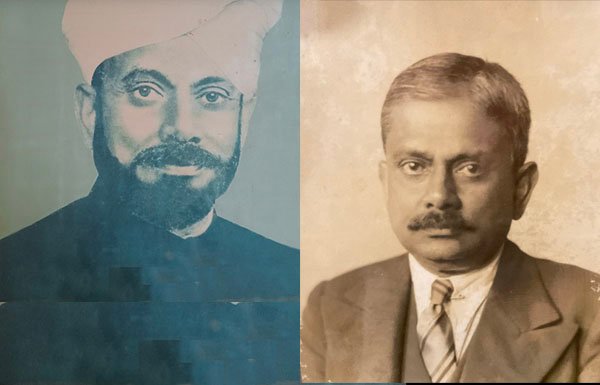
Image and Narrative points contributed by Dhiraj Banerjee and Family, West Bengal
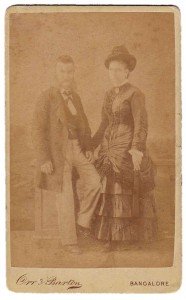
This is a composite photograph of my great-great-grandfather Girish Chandra Banerjee (left), and his second son (right), my great-grandfather Tarapada Banerjee. The two became pioneers within the Darjeeling Tea garden industry and left behind a legacy so powerful that nearly two centuries later the Indian tea industry as well as us, their descendants are all the better for it.
My tea planter ancestors’ story begins before the advent of tea estates when Darjeeling was a fertile jungle on an Eastern Himalayan mountain ridge. Inhabited by two indigenous communities, the Lepcha called it Dorje-ling, or “Land of the Thunderbolt”, a mythological location Indra’s weapon, the Vedic lord of weather, and its Limbu inhabitants called it ‘Tajenglung’ meaning ‘stones that talk to each other’.
The Darjeeling area, at the time, belonged to the Kingdom of Sikkim, although they were constantly clashing with Nepal over its boundary. In 1829, en route after resolving yet another dispute between Nepal and Sikkim, two East India Company officials, identified this crescent-shaped ridge as a potential summer retreat for British officials and their families. Subsequently, Sikkim ceded to ridge the company in 1835. Two years earlier, in 1833 the British Parliament had passed The Saint Helena Act that revoked the East India Company’s exclusive right to trade with China, including a hugely profitable tea trade. The company then began to experiment with tea growing in Assam to some success, and soon enough Darjeeling was part of that plan.
Records state that the East India Company sectioned large stretches of the Jalpaiguri and Darjeeling for tea plantations and placed them under several entrepreneurial companies (particularly Scottish owned) who employed managing agencies such as the reputed Andrew Yule and Company, Balmer Lawrie and Williamson Magor, all of whom managed the tea garden operations. The managers in turn hired technical staff, and labour for tea planting, processing and marketing. Between the 1830s and the early 1900s, thousands were recruited from Nepal, Sikkim, Tibet and Bhutan to clear forests, build European-style cottages, schools, a club and hotel, establish roads and a railway line. Consequently, the indigenous Lepcha and Limbu tribes suffered widespread deforestation and were displaced.
The tea managers established factories and imported machinery from Europe – machines weighing up to 100 tons were transported from the closest dockyards to gardens upriver by barge, and new roads were built to lug the machines by bullock carts hauled by large team of labourers. This is how the Hill Cart Road that connects Siliguri at the base of the foothills to Darjeeling came to be. By 1880, the train was bringing summer residents into the town and carrying tea out for export to the world. As the tea industry developed, well-to-do Indians were invited to invest in this venture. And this is where my great-great-grandfather Girish Chandra Banerjee made a choice of a lifetime that shaped the future of the tea industry, as well as his descendants.
In 1860, my great-great-grandfather Girish Chandra Banerjee moved from a village called Boral, in Serampore, Hooghly district to Calcutta. His family were rice-farming land owners. He was well-read, educated in English and was known to have beautiful handwriting. His penmanship caught the attention of the British railways, who hired him to craft invoices and schedules. Through his merit Girish Chandra quickly rose to be an officer in a British transport company, but when the railway line reached Darjeeling, the transport company shut down. By then he was married to my great great grandmother Gulab Sundari, and they went on to have three sons – Haripada, Tarapada, and Hemchandra. Girish Chandra then established a department store called G.C. Banerjee & Sons in Kurseong, in Darjeeling district, selling rations and goods and found immense success. We cannot say if he harboured a dream of owning a tea estate, or was incredibly entrepreneurial. What we do know is that he invested in his first tea garden in Siliguri, close to Darjeeling, at the foothills of the Himalayas. But destiny turned and tragically, at the age of just 30, my great-greatgrandfather Girish Chandra suddenly died.
Although his young sons were able to run their father’s shop successfully, the tea estate proved beyond their experience and had to be sold. We think the disappointment motivated them enough that in 1910, the brothers bought an estate in a distress sale from a European, Nurbong in Darjeeling, located below the Tindhariya railway station. The estate was big beyond anyone’s imagination – people said that one could start riding on horseback at sunrise, and still not reach its periphery at sunset. But Nurbong was a sick garden; the tea bushes were dying out, the forest was denuded and the machinery barely worked. Furthermore it had a liability of Rs. 80,000 at the time of sale (approximately ₹1.6 crore today)- By all standards, it was an unsound investment. Then the brothers bought another tea estate in Darjeeling and named it Happy Valley. Unfortunately, Happy Valley too was not happy. The elder brother, my great-granduncle, Haripada was preoccupied with the shop and the youngest brother Hemchandra was a solicitor in Calcutta (now Kolkata) so the running of the ailing gardens was placed into the hands of Tarapada, the middle son, my great grandfather.
Tarapada had no experience in running a tea estate let alone a sick one, but he was determined to turn them both around. He scoured through any literature or expertise he could find, and spent considerable time observing the process. He replaced the obsolete machinery, built a new factory, reforested the denuded hillsides, and tended to dying tea bushes. In 1916, another tragedy struck when Haripada, Tarapada, elder brother, my great-grand uncle, fell ill and passed away. Tarapada spared no time or energy in fixing the garden, and paid off the debt within two years. Within just eight years, my great-grandfather Tarapada, and Happy Valley had made a name for themselves – he was now the only Bengali man known to be an efficient tea planter. Nurbong along with Happy Valley became extremely profitable. The families began to enjoy a lavish life – abundant with privileges and riches. Happy Valley went on to be ranked as one of the highest-quality Darjeeling teas be held in regard not only in India but also in Europe as one of the most preferred hand-rolled teas in royal courts.
In 1928, the two brothers, Tarapada and Hemchandra agreed to an amicable division of their properties and Happy Valley Tea Estate came under the sole ownership of my great grandfather Tarapada. By now he had a large family of his own – four daughters and two sons with his wife, my great-grandmother Panna Sashi devi. In 1929, Tarapada bought another tea garden called Wilson from a British man David Wilson, and incorporated it into the Happy Valley estate. Now a 440 acre estate, it was run successfully by my great grandfather’s eldest son, my grandfather Amiyanath Banerjee, who eventually converted Happy Valley into a limited company. Tarapada had also bought the Makaibari Tea Estate in 1936, and incorporated it with Happy Valley. In the late 1980s Makaibari became the first estate to be fully organic, a developed a unique tea that won a patent. But in 1946 to leave clean inheritance divisions, he split the two estates again. He left his younger son Pashupati the Makaibari, and his eldest son Amiyanath, my grandfather, Happy Valley. The arrangement ran smoothly, helped with the fact that both brothers got along well. My grandfather, Amiyanath became the first Indian president of the Planters’ club in Darjeeling.
My grand-uncle Pashupati had one son, Rajah and two daughters, Reena and Ananya. Rajah studied in the UK and later took over Makaibari. Happy Valley passed on to the three sons of my grandfather Amiyanath – Manas, who migrated to the UK and became a software Engineer, Phalguni, my father who studied in Shantiniketan and Tridev, my youngest uncle. From 1960 to 1978 my father Phalguni also ran a Tea Estate called Vatakvar bought by his father, Amiyanath in 1958, and renamed it Sashitara Tea Company in honour of his parents. By 1979, the Indian government introduced new labour laws and taken over management of ailing tea estates with the aim of making them viable and returning them to the owners. The Tea Trading Corporation of India (TTCI) took over the management of Sashitara Tea Company , but when TTCI itself went bankrupt, the estates under them had to be auctioned off, and the Banerjee family was then left with only one remaining estate – Happy Valley.
Over time, things began to change as was inevitable. The Gorkhaland movement, a long-standing political campaign in northern West Bengal seeking a separate state for Nepali-speaking Indian Gorkhas had been an intermittent challenge for decades and the unrest often caused huge losses to tea gardens – both financially and the loss of crops when there was no labour to pluck the harvest. Moreover, the children of tea estate workers belonged to a more aspirational generation and chose not to return to do the work their forefathers had done. The company estates’ liabilities kept increasing and Happy Valley could no longer sustain its many stakeholders.
In the late 1990s, an agitation by the Gorkha movement proved to be the straw that broke the camel’s back. Yet again there was no one to pluck what had promised to be a bumper harvest on several estates. And we made a difficult decision to sell Happy Valley and its subsidiaries (my cousin Rajah too sold Makaibari) to more suitable business organisations who had the capacity, and funds to be able to manage the business.
My ancestors had created a legacy that became a household name amongst tea connoisseurs all over Bengal. And it is a great joy to witness that in the 21st century, almost 150 years later- Happy Valley remains a tea estate to be reckoned with. Over generations it has attracted innumerable tourists and tea-history enthusiasts. Darjeeling is land that has blessed us with extraordinary lives and experiences and it is because of our forefathers’ labour, that we have been the beneficiaries of privileges and choice. We are grateful for that legacy.