Image and Narrative contributed by Mehr Puri, West Bengal
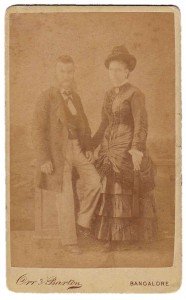
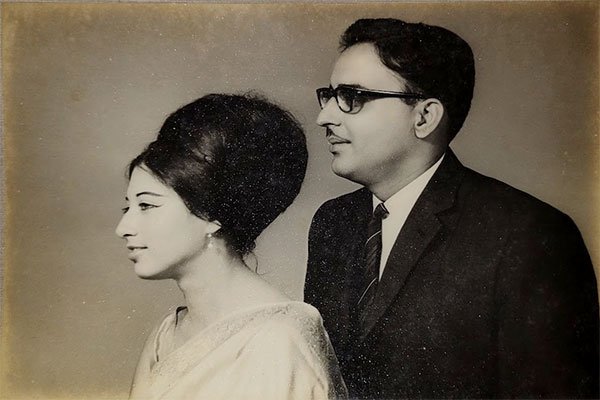
This is a photograph of my paternal grandparents Kewal Krishan Puri and Reva Puri whom I call Dadu and Granny, taken at the Bombay Photo Stores Pvt. Ltd Studio in Calcutta, (Kolkata), West Bengal. My granny’s maiden name was Barbara Dorothy Reynolds, and my Dadu was devoted to her. This is their love story.
In 2015, when I was 10-years-old, I experienced the feeling of loss for the first time. On the passing of my Dadu, Kewal Kewal Krishan Puri, an elderly family friend embraced me and whispered, “He was a man in love till his very last day” and admittedly so, be it dinner parties, family lunches, long drives, and really anywhere that he found a ready audience, Dadu – Kewal Krishan Puri would declare that he was a “refugee in love”.
Dadu was only a teenager in 1947, when India-Pakistan partition was declared and he was studying in Mussoorie (now in Uttarakhand state) at Oak Grove, a boarding school owned and run by Indian Railways since 1888. His schoolmates were primarily British, and Anglo-Indians whose fathers held jobs with the Indian railways. Dadu’s entire family was in Lahore (now in Pakistan) and they had to flee Lahore only a few days before August 15, 1947. Within days, they found themselves in the Kingsway camp in Delhi – the Indian capital’s largest refugee camp that accommodated about 3,00,000 partition refugees.
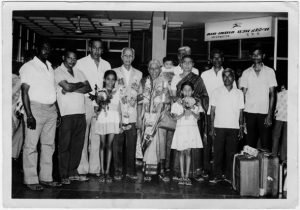
In the years after, the Puri family did everything they could to survive – they took on odd jobs and tried their hand at a pickle business that unfortunately failed. They did everything they could to pull themselves out of unfortunate conditions in which millions of people had abruptly found themselves. Matters did improve, but the times were rough, and the scars ran deep. Nonetheless, Dadu was encouraged to continue his education in Delhi, and he graduated in BA (hons) History from the esteemed St.Stephen’s College in 1958. After graduation he decided to seek work in Calcutta (now Kolkata) where his elder sister, my grand-aunt, Swaran had resettled with her husband. Swaran’s husband Tilak Raj Mehra was a former Air force officer, and had moved to Calcutta to work with the Kingdom of Bhutan, helping them develop radio technologies.
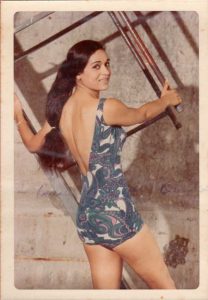
Upon landing his first job with the shipping department at a British company, Shaw Wallace, Dadu moved in with his elder sister and her family, and began to enjoy his time in Calcutta. With its cosmopolitan charm, Calcutta promised the vision of a good life and some incredible night jazz on Park Street. In 1964, Dadu met my beautiful granny, a 20 year old Barbara, at a party. Barbara was a half British and half Armenian- she was a fashion model and a flight hostess with Air India. In Dadu’s words, “She was a dream”.
My granny Barbara and her British father, my maternal great-grandfather, Diamond Charles Reynolds, had moved to Calcutta only a few years prior, after retiring from a life long job with the Indian Railways, in Jabalpore (now Jabalpur, Madhya Pradesh). Her Armenian mother, my maternal great-grandmother, chose a different life and had moved back to England, leaving granny behind when she was only three.
Granny and Dadu – Barbara and Kewal were soon head over heels in love; however, as most great love stories must, their love too faced several challenges. Dadu was the son of a traditional Punjabi family even though he was quite anglicised, and his friends would call him a ‘brown sahib’. Granny, on the other hand, was the only daughter of a conservative British father. “My father nearly passed out when I told him I was dating Kewal, a brown man”, she chuckles. Their love was as radical as it was vicarious, and soon enough, everyone got caught up in the romance of it and gave in. In 1967, my grandparents got married in a traditional church wedding, as well as a Hindu ceremony. Granny changed her name from Barbara to Reva to please her conservative mother-in-law, Vidyavati, and Dadu went to Church with Reva every Sunday, much to the chagrin of his mother.
At the beginning of their marriage, the happy couple continued to live in my grand-aunt Swaran’s home because Dadu couldn’t afford a house just yet. He often fussed, half jokingly, that it was the woe of being a ‘refugee in love’ that he had a wife before he had a house of his own. They eventually did get a home of their own in 1978, and in the interim had three children, my father Devraj, my uncle Vikram and aunt, Anjali. Granny decided to do more with her life – she trained in Aerobics and then established Calcutta’s first Aerobics centre in 1984 – with her married name Reva Puri at the helm. She even wrote the health column for The Telegraph as a fitness expert. Granny is 81 now, and she spends most of her time reading, watching TV and taking her mandatory siestas throughout the day.
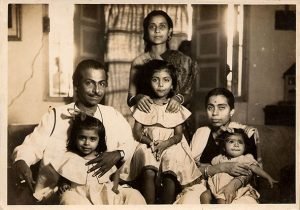
Growing up, I did not know another family like ours, where the grandfather was a brown Punjabi man and the grandmother, a British woman. Yet, we were like every other family: bickering over meals and on vacations, celebrating all the small and big joys. There were however some British disciplines that were non-negotiable – for instance we all had to be seated together for dinner at 8 p.m.
I am told that in a lifetime one is introduced to many kinds of love. However, my first introduction to romantic love is in its most radical form my grandparents’ love story- A love that defied social convention, authority and challenged the idea of belonging beyond race, religion and identity.